
Machine Learning is one of the key technologies behind today’s Artificial Intelligence revolution. Whether you’re watching a movie recommended by Netflix, asking ChatGPT a question, or checking Google Maps before leaving home, there’s a good chance Machine Learning is working behind the scenes.
Unlike traditional software, which follows a fixed set of rules, Machine Learning allows computers to learn from data. Instead of following instructions for every possible situation, these systems identify patterns, improve through experience, and make increasingly accurate predictions over time.
From helping doctors detect diseases earlier to allowing banks to spot suspicious transactions in seconds, Machine Learning is solving problems that once required hours of human work. Businesses are also using it to automate routine tasks, understand customer behavior, and make smarter decisions based on data.
So, what exactly is Machine Learning, and why has it become one of the most important technologies of the 21st century?
Let’s start with the basics and explore how Machine Learning is changing the technology we use every day.
Table of Contents
What Is Machine Learning?
Machine Learning (ML) is a branch of Artificial Intelligence that enables computers to learn from data and improve their performance without being explicitly programmed for every task. Instead of following a fixed set of instructions, Machine Learning systems analyze patterns, make predictions, and become more accurate as they process more information.
Put simply, Machine Learning teaches computers to learn from experience. By examining large datasets, ML algorithms can identify relationships, recognize trends, and make decisions based on what they have learned. This ability allows machines to solve complex problems that would be difficult or impossible to handle using traditional programming alone.
Chances are, you’ve already used Machine Learning several times today without even thinking about it. When Netflix recommends your next movie, Spotify builds a playlist based on your listening habits, Amazon suggests products you might actually want to buy, or Google Maps finds a faster route home, Machine Learning is working quietly in the background.
Unlike traditional software, where developers must write specific rules for every possible situation, Machine Learning models learn directly from examples. The more relevant and high-quality data they receive, the better they become at recognizing patterns and making accurate predictions.
Machine Learning is one of the driving forces behind modern Artificial Intelligence. It powers technologies such as speech recognition, image recognition, language translation, recommendation systems, fraud detection, medical diagnostics, autonomous vehicles, and generative AI tools.
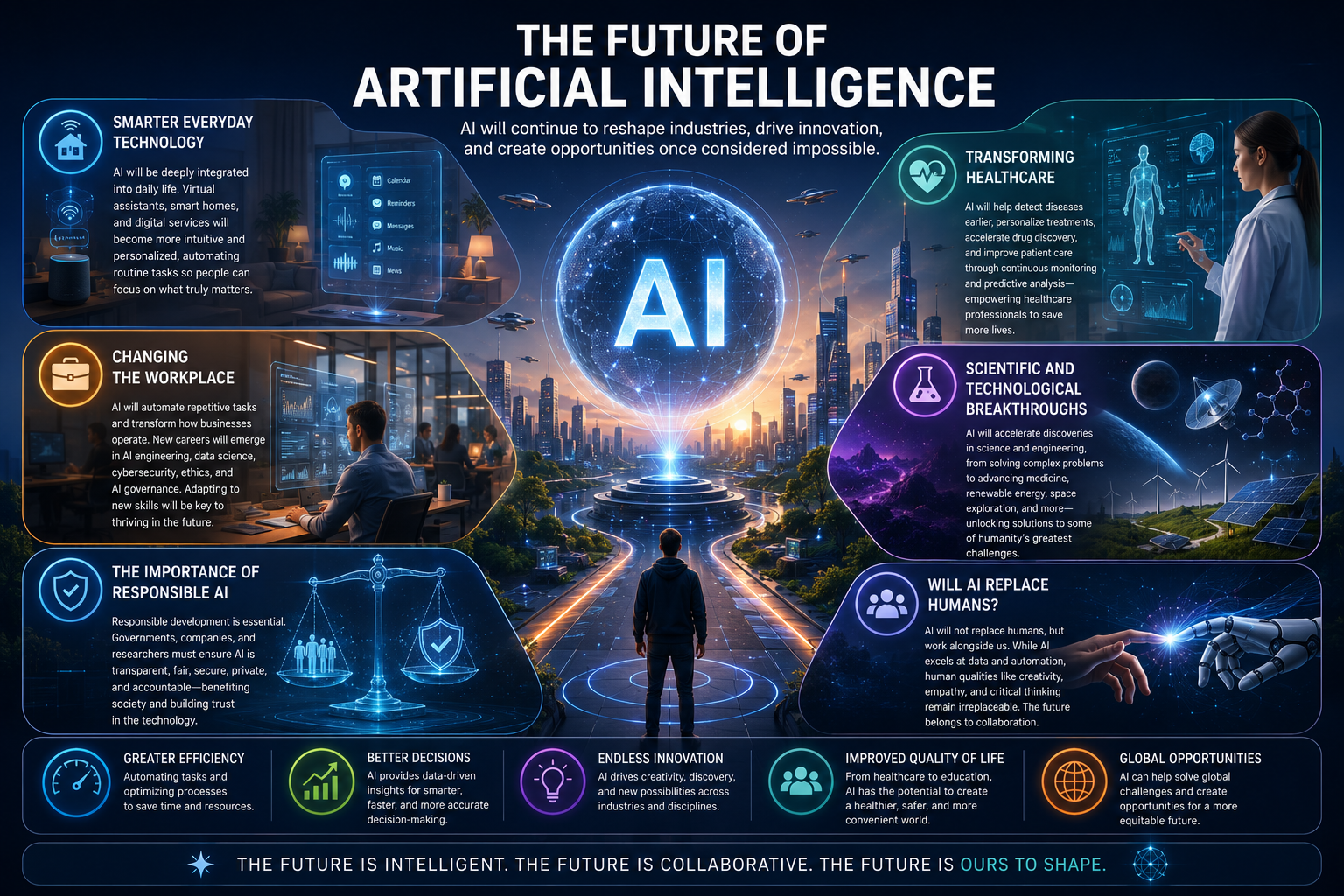
As more businesses collect and analyze data, Machine Learning is finding its way into almost every industry. Hospitals use it to support diagnoses, banks rely on it to detect fraud, retailers improve the shopping experience, and manufacturers optimize production. Most people never see it working—but they benefit from it every day.
Simply put, Machine Learning allows computers to learn from data instead of relying on fixed rules. The more data they process, the better they become at recognizing patterns, making predictions, and solving problems.
How Does Machine Learning Work?
Instead of following fixed instructions, Machine Learning algorithms learn from examples. Once they’ve learned enough, they can recognize patterns in new data and make predictions or decisions on their own.
Think of it as teaching a computer the same way you might teach a child to recognize different animals. Instead of explaining every detail with hundreds of rules, you simply show thousands of examples. Over time, the child begins to recognize patterns and can correctly identify animals they have never seen before. Machine Learning follows a similar process.
Every Machine Learning system relies on an algorithm-a set of mathematical rules that learns from data, recognizes patterns, and makes predictions. As it processes more examples, the algorithm gradually improves its accuracy and becomes better at solving the task it was designed for.
Although different Machine Learning models use different techniques, they generally follow the same four-step process.
1. Data Collection
Every Machine Learning project starts with data. This data may include text, images, videos, audio recordings, sensor readings, customer transactions, or numerical information collected from various sources.
The quality of the data is one of the most important factors in determining how accurate a Machine Learning model will become. The better the data, the better the results. Large, well-organized datasets help Machine Learning models recognize patterns more accurately and make better predictions.
A good example is your email inbox. Spam filters learn by analyzing millions of emails that have already been marked as spam or legitimate messages. Over time, they become better at recognizing unwanted emails before they even reach your inbox.
2. Training the Model
Once enough data has been collected, it is time to train the Machine Learning model.
During training, the algorithm looks for patterns and relationships in the data. Instead of memorizing individual examples, it learns what those examples have in common. That allows it to recognize similar patterns when it encounters new data later on.
Training doesn’t always take the same amount of time. A simple model might be ready in just a few minutes, while more advanced AI systems can take days or even weeks to train using powerful computers or cloud infrastructure.
3. Making Predictions
After training is complete, the Machine Learning model can analyze new data that it has never encountered before.
Imagine showing a trained model a photo it has never seen before. If it has learned the right patterns, it can recognize whether the image contains a cat, a dog, or something completely different. The same principle is behind streaming services that recommend your next movie and online stores that suggest products you might actually be interested in.
That’s what makes Machine Learning so powerful. It doesn’t simply memorize information-it learns from experience and applies that knowledge when faced with something new.
4. Continuous Improvement
Unlike traditional software, many Machine Learning systems continue to improve as they receive new information.
The more data these systems receive, the better they become. Streaming platforms improve their recommendations as your viewing habits change, navigation apps update routes using live traffic data, and fraud detection systems quickly adapt to new scams.
Because they continue learning over time, these models can adapt to changing conditions and keep improving as new data becomes available.
Why Does Machine Learning Keep Improving?
One of the reasons Machine Learning is so powerful is that it gets better with experience. The more high-quality data it processes, the more accurate and reliable its predictions become.
Faster computers, powerful GPUs, and cloud computing have made it possible to train Machine Learning models much more quickly than in the past. Combined with access to massive datasets, these advances have led to breakthroughs in medical diagnosis, autonomous driving, natural language processing, and Generative AI.
Today, Machine Learning is no longer limited to research labs. It powers many of the apps, websites, and digital services people use every day-often without them even realizing it. As technology continues to evolve, Machine Learning will become an even bigger part of our daily lives.
In short: Machine Learning learns from data, recognizes patterns, makes predictions, and continues improving as more information becomes available.
Types of Machine Learning
Not all Machine Learning models learn in the same way. Depending on the problem they’re trying to solve and the type of data they receive, they use different learning methods.
Don’t worry if these names sound technical at first. Once you understand the basic idea behind each one, the differences become much easier to recognize.
The three main types of Machine Learning are:
- Supervised Learning
- Unsupervised Learning
- Reinforcement Learning
Each method has its own strengths and is better suited to certain types of problems. That’s why different Machine Learning models are used for different real-world tasks.
Supervised Learning
Supervised Learning is the most widely used type of Machine Learning. It’s the method behind many of the AI systems people interact with every day. That simply means every training example already includes the correct answer, allowing the model to compare its predictions with the expected result.
For example, imagine you want to teach a computer to recognize spam emails. During training, the algorithm receives thousands of emails that have already been labeled as either “Spam” or “Not Spam.” By studying these examples, it learns to identify the patterns that distinguish unwanted messages from legitimate ones.
Once training is complete, the model can analyze new emails and predict whether they are likely to be spam.
Supervised Learning is widely used for:
- Email spam detection
- Credit risk assessment
- House price prediction
- Medical diagnosis
- Sales forecasting
- Image classification
Because the model receives immediate feedback during training, it gradually improves its accuracy. The more examples it analyzes, the better it becomes at making correct predictions.
Unsupervised Learning
Unlike Supervised Learning, Unsupervised Learning doesn’t receive the correct answers in advance. Instead, it works with unlabeled data and has to discover patterns on its own.
Rather than predicting a specific answer, the goal is to find hidden patterns, group similar information together, or uncover relationships that weren’t obvious before.
Imagine an online store with millions of customers. Instead of telling the model which customers like which products, it simply provides purchase data. Over time, the model begins to identify groups of customers with similar shopping habits-all without anyone manually labeling the data.
Companies can use these insights to create more personalized marketing campaigns, recommend products that customers are more likely to buy, or better understand how different groups of customers behave.
Common applications include:
- Customer segmentation
- Market research
- Recommendation systems
- Fraud detection
- Data clustering
- Pattern discovery
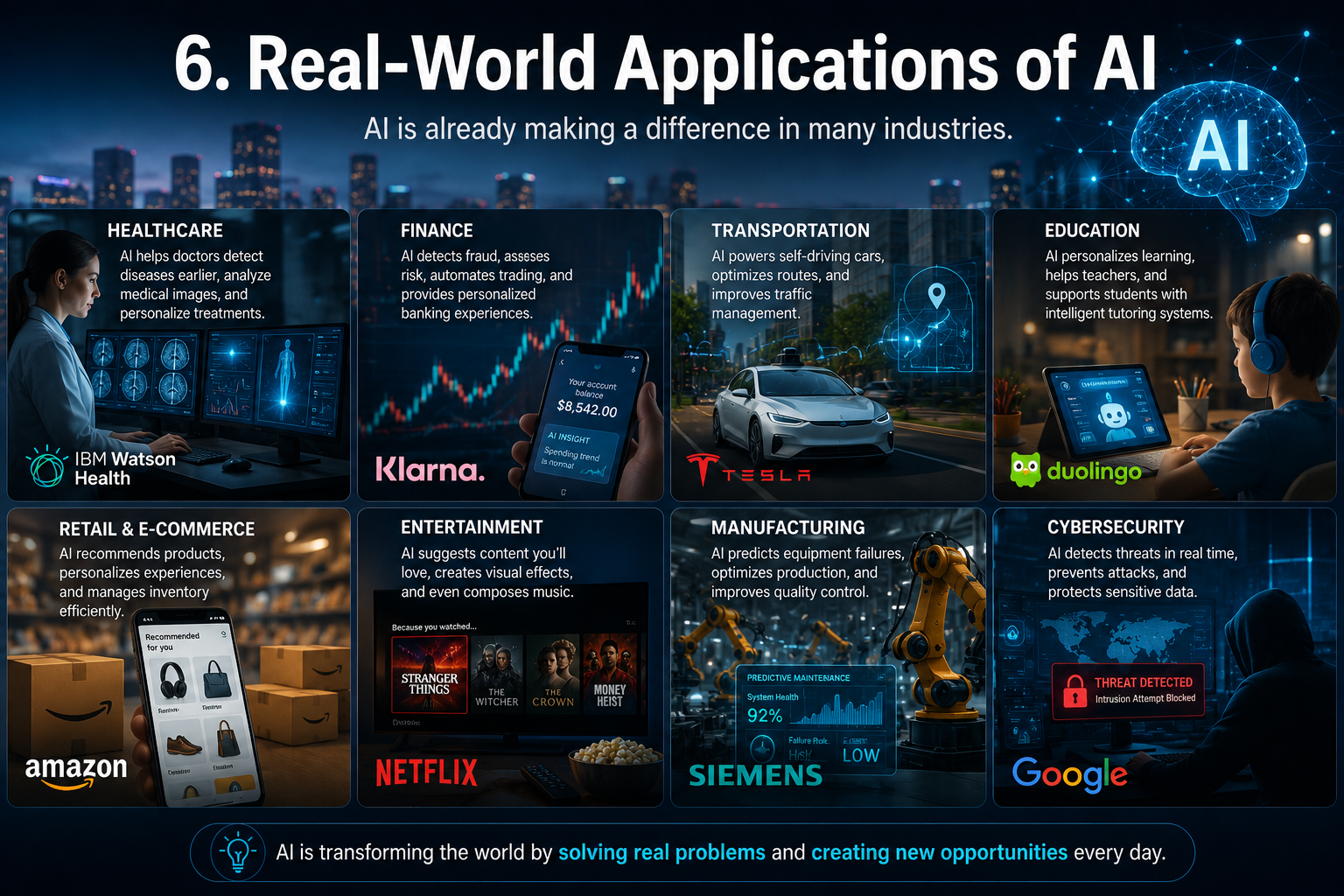
Unsupervised Learning is particularly useful when there is a huge amount of data but very little labeled information. In situations like these, it can uncover valuable insights that might otherwise go unnoticed.
Reinforcement Learning
Reinforcement Learning takes a completely different approach.
Instead of learning from labeled examples, an intelligent agent learns through trial and error. Every action receives feedback in the form of rewards or penalties, encouraging the system to make better decisions over time.
Imagine teaching a robot to navigate through a maze. Every time it reaches the exit, it receives a reward. If it hits a wall or takes an inefficient path, it receives a penalty. After many attempts, the robot gradually learns the best route.
It’s surprisingly similar to how we learn in everyday life. We make mistakes, learn from them, and gradually get better through experience.
Today, Reinforcement Learning is used in a wide range of applications, including:
- Robotics
- Autonomous vehicles
- Video games
- Industrial automation
- Resource management
- Intelligent decision-making systems
Many of today’s most advanced AI systems rely on Reinforcement Learning to solve complex problems. As computing power continues to grow, this approach is expected to play an even bigger role in robotics, autonomous vehicles, and intelligent decision-making.
Which Type of Machine Learning Is Most Common?
Among the three approaches, Supervised Learning remains the most widely used because organizations often have access to historical data that can be labeled for training.
However, as more data becomes available every year, Unsupervised Learning is becoming increasingly important for discovering hidden insights without human intervention.
At the same time, Reinforcement Learning is driving innovation in robotics, autonomous systems, and advanced Artificial Intelligence applications where continuous learning and adaptation are essential.
In practice, many modern AI systems combine multiple Machine Learning techniques to achieve better performance, allowing them to solve increasingly complex problems with greater accuracy.
Key Takeaway: Supervised Learning learns from labeled data, Unsupervised Learning discovers patterns in unlabeled data, and Reinforcement Learning improves through rewards and penalties. Together, these three approaches form the foundation of modern Machine Learning.
Real-World Applications of Machine Learning
Machine Learning has become an essential technology in modern society, powering many of the digital services and intelligent systems we use every day. From streaming platforms and online shopping to healthcare and finance, Machine Learning helps organizations analyze massive amounts of data, automate complex tasks, and make smarter decisions.
As computing power continues to increase and more data becomes available, the number of Machine Learning applications continues to grow across virtually every industry.
Below are some of the most common real-world applications of Machine Learning.
Healthcare
Machine Learning is transforming healthcare by helping doctors diagnose diseases earlier, personalize treatments, and improve patient outcomes.
Modern AI systems can analyze medical images such as X-rays, CT scans, and MRIs to identify abnormalities that may be difficult for the human eye to detect. Machine Learning is also used to predict disease risks, discover new drugs, and monitor patients in real time using wearable devices.
These technologies allow healthcare professionals to make faster, more accurate decisions while reducing costs and improving the quality of care.
Finance
Financial institutions rely heavily on Machine Learning to detect fraud, assess credit risk, and automate investment strategies.
Banks analyze millions of transactions every day, allowing Machine Learning models to identify unusual spending patterns that may indicate fraudulent activity. Investment firms also use predictive algorithms to analyze market trends and support data-driven trading decisions.
In addition, Machine Learning helps financial organizations improve customer service through AI-powered chatbots and personalized financial recommendations.
E-commerce
Online retailers use Machine Learning to create highly personalized shopping experiences.
When you browse products on websites like Amazon or receive product recommendations based on previous purchases, Machine Learning algorithms are analyzing your preferences and behavior.
Retail companies also use Machine Learning to optimize inventory management, forecast customer demand, and improve pricing strategies.
These capabilities increase customer satisfaction while helping businesses maximize sales and reduce operational costs.
Entertainment
Streaming services such as Netflix, Spotify, and YouTube depend on Machine Learning to recommend content that matches each user’s interests.
Rather than showing the same movies, songs, or videos to everyone, Machine Learning analyzes viewing history, listening habits, search activity, and user interactions to deliver personalized recommendations.
This personalized experience is one of the main reasons people keep coming back to streaming platforms
Transportation
Machine Learning plays a critical role in modern transportation systems.
Navigation apps analyze live traffic conditions to recommend the fastest routes, while logistics companies optimize delivery schedules using predictive algorithms.
Machine Learning is also one of the core technologies behind autonomous vehicles, helping them recognize traffic signs, detect pedestrians, avoid obstacles, and make real-time driving decisions.
As self-driving technology continues to evolve, Machine Learning will become even more important for improving road safety and transportation efficiency.
Cybersecurity
Cybersecurity professionals use Machine Learning to identify cyber threats before they cause damage.
Instead of relying only on predefined security rules, Machine Learning systems continuously analyze network activity and identify unusual behavior that could indicate malware, phishing attacks, or unauthorized access attempts.
Because cybercriminals constantly develop new attack methods, Machine Learning allows security systems to adapt much faster than traditional software.
Manufacturing
Manufacturers use Machine Learning to improve production efficiency and reduce equipment failures.
Predictive maintenance systems analyze sensor data from industrial machines to identify signs of wear before breakdowns occur. This helps companies schedule maintenance at the right time, reducing downtime and saving millions of dollars in repair costs.
Machine Learning is also used for quality control, robotics, supply chain optimization, and factory automation.
Education
Machine Learning is making education more personalized and accessible.
Online learning platforms use intelligent algorithms to recommend lessons based on each student’s progress, identify learning difficulties, and adapt educational content to individual needs.
Teachers can also use Machine Learning tools to automate grading, analyze student performance, and provide targeted support where it is needed most.
Why Machine Learning Matters
Machine Learning is no longer just for technology companies. It has become a powerful tool that helps organizations solve problems faster, improve decision-making, reduce costs, and deliver better experiences to customers.
As Artificial Intelligence continues to evolve, Machine Learning will remain one of the key technologies driving innovation across healthcare, finance, education, transportation, manufacturing, entertainment, and countless other industries.
Key Takeaway: Machine Learning is already transforming the way we live and work. From personalized recommendations and fraud detection to medical diagnosis and autonomous vehicles, its real-world applications continue to expand as technology advances.
Benefits of Machine Learning
Machine Learning has become one of the most valuable technologies of the digital age because it enables computers to learn from data, automate complex processes, and continuously improve over time. Organizations across nearly every industry are using Machine Learning to increase efficiency, reduce costs, and make better decisions based on data.
As Machine Learning models become more sophisticated and access to data continues to grow, their benefits are becoming even more significant.
Here are some of the biggest advantages of Machine Learning.
Automates Repetitive Tasks
One of the greatest benefits of Machine Learning is its ability to automate repetitive and time-consuming tasks.
Businesses can use Machine Learning systems to process documents, classify emails, detect fraudulent transactions, analyze customer feedback, and perform countless other activities without constant human intervention.
By automating routine work, employees can focus on more creative and strategic responsibilities while organizations improve productivity and reduce operational costs.
Improves Decision-Making
Machine Learning helps organizations make faster and more informed decisions by analyzing massive amounts of data that would be impossible for humans to process manually.
Instead of relying on assumptions or intuition, businesses can identify trends, predict future outcomes, and uncover valuable insights based on real data.
This data-driven approach supports better decision-making in industries such as finance, healthcare, manufacturing, and retail.
Delivers Personalized Experiences
Many of the digital services people use every day rely on Machine Learning to provide personalized experiences.
Streaming platforms recommend movies and music based on viewing habits, online stores suggest products that match customer interests, and social media platforms prioritize content according to user preferences.
This personalization improves customer satisfaction while increasing engagement and loyalty.
Detects Fraud and Security Threats
Machine Learning plays a critical role in improving cybersecurity and financial security.
By continuously analyzing patterns in transactions and network activity, Machine Learning systems can identify suspicious behavior that may indicate fraud, identity theft, or cyberattacks.
Unlike traditional security software that depends on predefined rules, Machine Learning models can adapt to new threats as they emerge, making them far more effective in rapidly changing environments.
Increases Accuracy
Machine Learning models often become more accurate as they receive additional data.
For example, image recognition systems improve their ability to identify objects after analyzing millions of images, while language models become better at understanding human communication through exposure to vast amounts of text.
This continuous improvement allows Machine Learning systems to perform increasingly complex tasks with impressive levels of precision.
Processes Massive Amounts of Data
Modern organizations generate enormous volumes of data every day.
Machine Learning can analyze millions—or even billions—of records much faster than human analysts, uncovering hidden patterns and valuable insights that might otherwise go unnoticed.
This capability makes Machine Learning essential for scientific research, business intelligence, healthcare analytics, and many other data-intensive fields.
Supports Innovation
Machine Learning has become one of the main drivers of technological innovation.
It powers breakthroughs in areas such as autonomous vehicles, robotics, medical diagnostics, smart manufacturing, natural language processing, and generative AI.
As technology continues to evolve, Machine Learning will remain at the center of many future innovations that reshape industries and improve everyday life.
Scales Efficiently
Once trained, Machine Learning models can process thousands or even millions of tasks with minimal additional effort.
Whether analyzing customer transactions, monitoring industrial equipment, or delivering personalized recommendations, Machine Learning systems can scale to handle increasing workloads without requiring proportional increases in human resources.
This scalability makes Machine Learning particularly valuable for businesses experiencing rapid growth.
Why Businesses Invest in Machine Learning
Organizations invest in Machine Learning because it helps them become more efficient, competitive, and customer-focused.
By automating processes, improving decision-making, reducing errors, and delivering personalized experiences, Machine Learning creates measurable value across a wide range of industries.
As data continues to play a central role in the global economy, companies that successfully adopt Machine Learning will be better positioned to innovate and respond to changing market demands.
Key Takeaway: Machine Learning enables organizations to automate tasks, improve accuracy, make smarter decisions, detect fraud, personalize customer experiences, and unlock valuable insights from large datasets. These advantages have made Machine Learning one of the most transformative technologies of the 21st century.
Challenges and Limitations of Machine Learning
While Machine Learning offers incredible opportunities across many industries, it is not a perfect technology. Like any advanced system, Machine Learning has limitations that organizations must understand before implementing it.
The performance of a Machine Learning model depends heavily on the quality of the data, the algorithms used, and the way the system is trained. Without proper planning and continuous monitoring, Machine Learning models can produce inaccurate predictions, reinforce existing biases, or make decisions that are difficult to explain.
Understanding these challenges is essential for developing responsible and trustworthy AI systems.
Data Quality Matters
Machine Learning models are only as good as the data they learn from.
If the training data is incomplete, outdated, inaccurate, or biased, the model is likely to produce unreliable results. This is often summarized by the phrase “Garbage In, Garbage Out” (GIGO)—poor-quality input leads to poor-quality output.
For example, if a medical AI system is trained using data from only one population group, it may perform poorly when diagnosing patients from different backgrounds.
To build reliable Machine Learning systems, organizations must invest in collecting accurate, diverse, and high-quality datasets.
Bias in Machine Learning
Bias is one of the biggest challenges in modern Machine Learning.
Because algorithms learn from historical data, they can unintentionally inherit the same biases and inequalities present in that data. As a result, Machine Learning systems may produce unfair or discriminatory outcomes.
For example, if a hiring algorithm is trained using historical recruitment data that favors one demographic over another, it may continue making biased hiring recommendations.
Developers must regularly test and evaluate Machine Learning models to reduce bias and ensure fair, ethical decision-making.
Lack of Explainability
Many advanced Machine Learning models, especially deep learning systems, are often described as “black boxes.”
Although these models can make highly accurate predictions, it is sometimes difficult to understand exactly how they reached a particular decision.
This lack of transparency can be problematic in sensitive fields such as healthcare, finance, and law, where professionals need to understand the reasoning behind automated decisions.
Researchers are actively developing techniques in Explainable AI (XAI) to make Machine Learning systems more transparent and easier to interpret.
High Computational Requirements
Training advanced Machine Learning models often requires significant computing power.
Large datasets and complex algorithms demand powerful hardware such as Graphics Processing Units (GPUs) or specialized AI accelerators. Training a sophisticated model can take hours, days, or even weeks, depending on its complexity.
For smaller organizations, these infrastructure costs can be a barrier to adopting Machine Learning solutions.
However, cloud computing platforms have made advanced Machine Learning more affordable and accessible than ever before.
Privacy and Security Concerns
Machine Learning systems often rely on vast amounts of personal and sensitive data.
If this data is not handled responsibly, it can create serious privacy and security risks. Organizations must comply with data protection regulations and implement strong security measures to protect user information.
There is also growing concern about adversarial attacks, where malicious actors intentionally manipulate input data to fool Machine Learning models into making incorrect predictions.
Developing secure and privacy-preserving Machine Learning systems has become one of the most important areas of AI research.
Continuous Maintenance
Many people assume that a Machine Learning model can be trained once and then used indefinitely. In reality, this is rarely the case.
As markets, customer behavior, and real-world conditions change, Machine Learning models may become less accurate over time. This phenomenon is known as model drift.
To maintain high performance, organizations must regularly update datasets, retrain models, and monitor their results.
Ethical Challenges
The rapid growth of Machine Learning has also raised important ethical questions.
Organizations must consider how AI systems affect people’s privacy, employment, fairness, and decision-making. Responsible development includes ensuring transparency, accountability, and human oversight when Machine Learning is used in high-impact situations.
Governments and international organizations are introducing regulations such as the EU AI Act and international AI governance frameworks to promote the responsible use of Artificial Intelligence and Machine Learning.
Why These Challenges Matter
Despite its limitations, Machine Learning continues to transform industries worldwide by enabling smarter decisions, increasing automation, and driving new forms of innovation.
Understanding its challenges does not reduce its value-it helps organizations build systems that are more accurate, secure, transparent, and fair.
As researchers continue advancing algorithms, improving data quality, and developing responsible AI governance, many of today’s limitations are expected to become less significant over time.
Key Takeaway: Machine Learning is a powerful technology, but its success depends on high-quality data, responsible development, transparency, continuous monitoring, and ethical use. Organizations that address these challenges are better positioned to build accurate, reliable, and trustworthy AI systems.
Machine Learning vs Artificial Intelligence
Although the terms Artificial Intelligence (AI) and Machine Learning (ML) are often used interchangeably, they refer to different concepts. Machine Learning is a subset of Artificial Intelligence that enables computers to learn from data rather than relying solely on predefined rules.
| Artificial Intelligence | Machine Learning |
|---|---|
| Broad field of computer science | Subset of AI |
| Focuses on making machines intelligent | Focuses on learning from data |
| Can use rule-based systems, learning algorithms, or both | Learns patterns from data |
| Includes ML, robotics, planning, reasoning | Includes supervised, unsupervised and reinforcement learning |
| Includes Deep Learning as one of its techniques | Includes Deep Learning as a specialized subset |
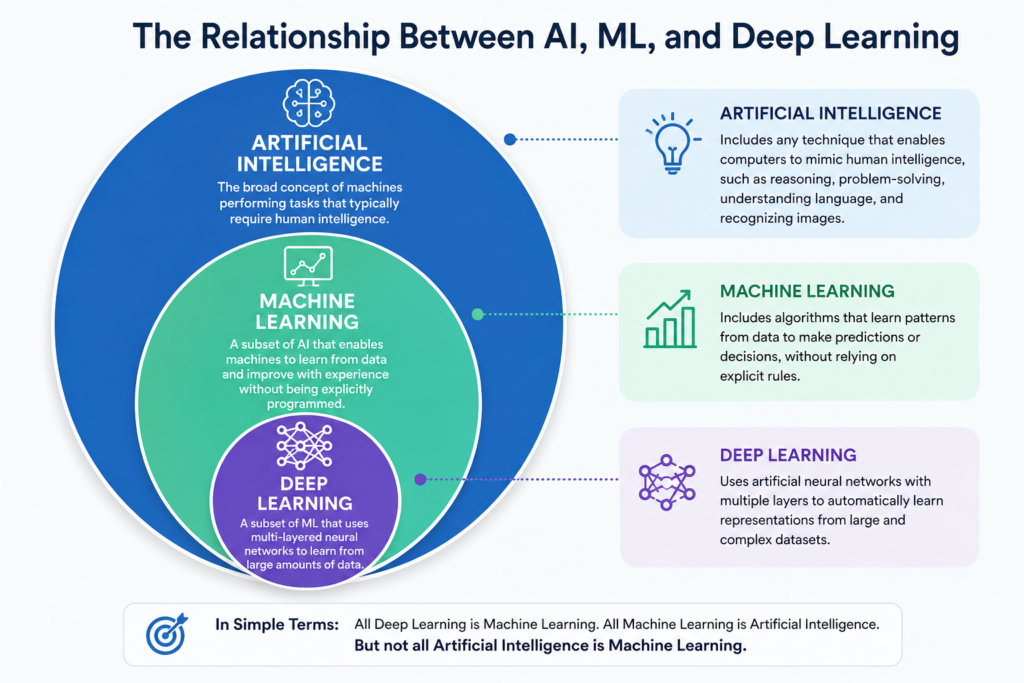
Figure: Relationship between Artificial Intelligence, Machine Learning, and Deep Learning. Machine Learning is a subset of Artificial Intelligence, while Deep Learning is a subset of Machine Learning.
Artificial Intelligence is the broader concept of creating machines capable of performing tasks that typically require human intelligence, such as reasoning, problem-solving, decision-making, understanding language, and recognizing images.
Machine Learning powers many modern AI systems, but Artificial Intelligence also includes techniques that do not rely on Machine Learning, such as rule-based systems, search algorithms, planning, and symbolic reasoning.
In simple terms, all Machine Learning is Artificial Intelligence, but not all Artificial Intelligence is Machine Learning.
Artificial Intelligence: The Bigger Picture
Artificial Intelligence (AI) is a broad field of computer science focused on creating systems that can perform tasks that normally require human intelligence, such as reasoning, learning, perception, language understanding, and decision-making.
Some AI systems rely on Machine Learning to learn from data, while others use rule-based systems, search algorithms, knowledge representation, optimization techniques, robotics, or symbolic reasoning.
The goal of Artificial Intelligence is to build systems capable of reasoning, learning, solving problems, making decisions, perceiving their environment, and interacting intelligently with humans.
Examples of Artificial Intelligence include:
- Virtual assistants (e.g., Siri and Google Assistant)
- AI chatbots powered by Large Language Models (LLMs), such as ChatGPT, Claude, or Gemini
- Autonomous robots
- Facial recognition systems
- Expert systems used in healthcare
- Self-driving vehicles
Machine Learning powers many of today’s most advanced AI systems, but Artificial Intelligence also includes techniques that do not rely on learning from data. Together, these complementary approaches make modern intelligent systems possible.
Key Takeaway
- Artificial Intelligence is the broad field.
- Machine Learning is a subset of Artificial Intelligence.
- Deep Learning is a specialized subset of Machine Learning.
Machine Learning: Learning from Data
Machine Learning focuses specifically on creating algorithms that improve automatically through experience.
Instead of programming every possible rule, developers provide large datasets that allow the algorithm to identify patterns and make predictions independently.
This makes Machine Learning particularly effective for problems involving large amounts of data where manually writing rules would be impractical.
Examples include:
- Spam email detection
- Product recommendations
- Fraud detection
- Speech recognition
- Image classification
- Demand forecasting
In general, the more relevant and higher-quality data a model learns from, the better its performance is likely to become.
Key Differences
Although they work together, Artificial Intelligence and Machine Learning have different goals and scopes.
Machine Learning in one sentence
Machine Learning is the branch of Artificial Intelligence that enables computers to learn from data instead of relying solely on explicitly programmed rules.
| Artificial Intelligence | Machine Learning |
|---|---|
| Broad field of computer science | Subset of Artificial Intelligence |
| Focuses on creating intelligent systems | Focuses on learning from data |
| Can use many different techniques | Relies on algorithms trained with data |
| May use rule-based systems | Continuously improves through learning |
| Includes robotics, reasoning, planning, and more | Primarily focused on learning patterns from data and making predictions |
Which One Is More Important?
Neither Artificial Intelligence nor Machine Learning is more important than the other.
Artificial Intelligence provides the broader framework for creating intelligent systems, while Machine Learning is one of the most effective approaches used to achieve that goal. Many of today’s most advanced AI applications-including recommendation systems, language translation, image recognition, and generative AI-are powered by Machine Learning.
Together, these technologies are driving innovation across industries and transforming the way people work, communicate, and solve complex problems.
Key Takeaway: Artificial Intelligence is the broad field of creating intelligent systems, while Machine Learning is a subset of AI that enables computers to learn from data. Machine Learning is one of the key technologies powering many of today’s most advanced AI systems.
Now that we’ve explored the relationship between Artificial Intelligence and Machine Learning, the next chapter takes a closer look at Deep Learning—one of the most powerful and rapidly evolving areas of modern AI.
Machine Learning vs Deep Learning
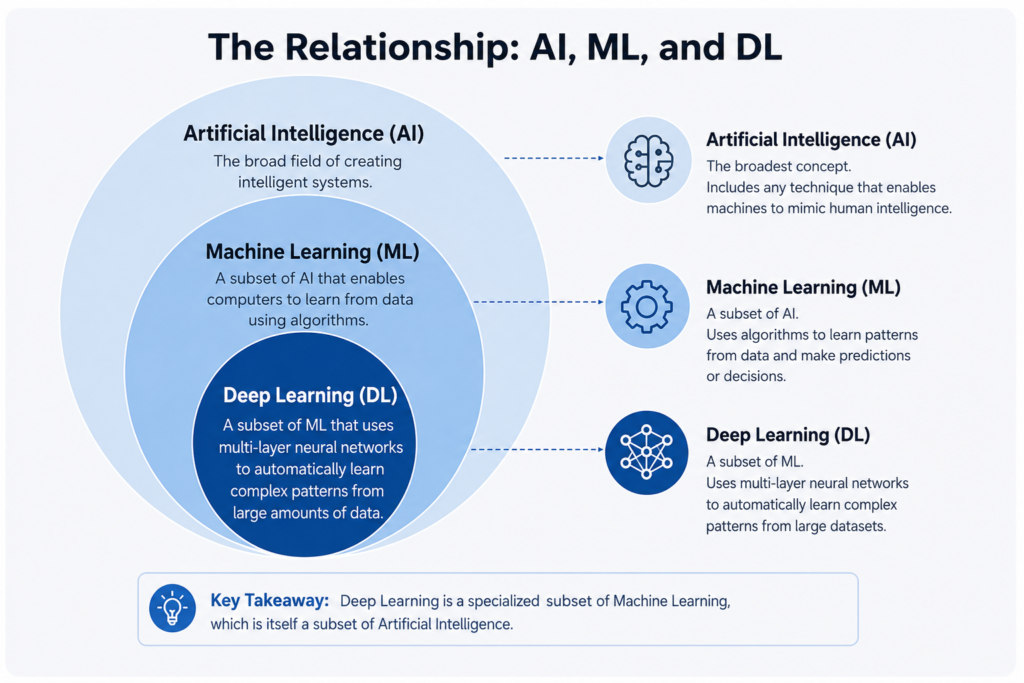
Machine Learning and Deep Learning are closely related technologies, but they are not the same. Deep Learning is a subset of Machine Learning that uses multi-layer artificial neural networks to automatically learn complex patterns from data and solve highly complex problems.
Both technologies enable computers to learn from data, but they differ in how they learn, the amount of data they require, and the types of problems they can solve.
What Is Machine Learning?
Machine Learning uses algorithms that learn patterns from data to make predictions, classifications, or decisions without being explicitly programmed for every task.
In many traditional Machine Learning approaches, developers often need to select relevant features or characteristics from the data before training the model. The algorithm then uses these features to build predictive models.
Machine Learning works well for structured data and is commonly used in applications such as:
- Spam email filtering
- Credit risk assessment
- Sales forecasting
- Customer segmentation
- Fraud detection
- Recommendation systems
Because traditional Machine Learning models are generally less complex, they often require less computing power and smaller datasets than Deep Learning models.
What Is Deep Learning?
Deep Learning is an advanced form of Machine Learning inspired by the structure of the human brain.
Instead of relying heavily on manually selected features, Deep Learning models use artificial neural networks with multiple processing layers to automatically learn increasingly complex patterns from raw data.
This ability makes Deep Learning particularly effective for tasks involving images, speech, video, and natural language.
Some of the most impressive AI breakthroughs in recent years—including ChatGPT, image generators, voice assistants, and autonomous vehicles—have been made possible by Deep Learning.
Key Differences
Although Machine Learning and Deep Learning share the same goal of learning from data, they differ in several important ways.
| Machine Learning | Deep Learning |
|---|---|
| Usually requires manual feature engineering | Automatically learns features from raw data |
| Works well with smaller datasets | Requires large datasets |
| Lower computational requirements | Typically requires powerful GPUs or TPUs |
| Easier to interpret | Often more difficult to interpret (“black box”) |
| Faster to train | Longer training time |
| Effective for structured/tabular data | Excels with images, audio, video and text |
| Typical algorithms: Decision Trees, Random Forests, SVM, Linear Regression | Typical architectures: CNNs, RNNs, Transformers |
When Is Machine Learning the Better Choice?
Machine Learning is often the preferred solution when:
- The dataset is relatively small.
- The problem is well-defined.
- Fast model training is important.
- Results need to be easier to explain.
- Computing resources are limited.
Many businesses continue to rely on traditional Machine Learning because it provides excellent performance without requiring enormous amounts of data or expensive hardware.
When Is Deep Learning the Better Choice?
Deep Learning becomes the better option when dealing with massive datasets and highly complex problems.
It excels at tasks such as:
- Image recognition
- Speech recognition
- Natural language processing
- Machine translation
- Medical image analysis
- Autonomous driving
- Generative AI
- Large Language Models (LLMs)
Although Deep Learning models require significantly more computational resources and training data, they often achieve state-of-the-art performance in these domains.
Choosing between Machine Learning and Deep Learning depends on the available data, computational resources, and the complexity of the problem. Selecting the right approach is often more important than choosing the most advanced one.
How They Work Together
Machine Learning and Deep Learning are complementary technologies that often work together.
Many AI systems combine both approaches depending on the task being performed. Simpler predictive tasks may use traditional Machine Learning algorithms, while more complex perception, vision, and language tasks rely on Deep Learning.
Choosing between them depends on factors such as the amount of available data, computing resources, project goals, and the complexity of the problem.
As AI continues to evolve, both Machine Learning and Deep Learning will remain fundamental technologies driving innovation across industries.
Key Takeaway: Deep Learning is a specialized branch of Machine Learning that uses artificial neural networks to solve highly complex problems. While Machine Learning is often sufficient for structured data and simpler tasks, Deep Learning excels in applications such as computer vision, speech recognition, and generative AI.
Popular Machine Learning Algorithms
Machine Learning is powered by a wide variety of algorithms, each designed to solve specific types of problems. Some algorithms are better at making predictions, while others excel at finding hidden patterns or classifying information.
Choosing the right algorithm depends on factors such as the size of the dataset, the complexity of the problem, and the desired outcome.
Below are some of the most widely used Machine Learning algorithms.
Linear Regression
Linear Regression is one of the simplest and most widely used Machine Learning algorithms.
It is primarily used to predict numerical values by identifying relationships between variables.
For example, a real estate company can use Linear Regression to estimate the price of a house based on factors such as its size, location, age, and number of bedrooms.
Because of its simplicity and effectiveness, Linear Regression is often one of the first algorithms that data scientists learn.
Logistic Regression
Despite its name, Logistic Regression is mainly used for classification rather than prediction.
Instead of estimating numerical values, it determines the probability that an item belongs to a specific category.
Common applications include:
- Spam email detection
- Fraud detection
- Medical diagnosis
- Customer churn prediction
Logistic Regression remains popular because it is fast, reliable, and easy to interpret.
Decision Trees
Decision Trees solve problems by creating a series of questions that gradually lead to a decision.
Each branch of the tree represents a possible outcome until the algorithm reaches a final prediction.
For example, a bank evaluating a loan application might ask questions such as:
- Does the applicant have a stable income?
- What is their credit score?
- Do they have existing debt?
Based on the answers, the algorithm predicts whether the loan should be approved.
Decision Trees are widely used because they are easy to understand and visualize.
Random Forest
Random Forest improves upon Decision Trees by combining many different trees into a single model.
Instead of relying on one decision tree, the algorithm builds hundreds or even thousands of trees and combines their predictions.
This approach usually produces more accurate and reliable results while reducing the risk of overfitting.
Random Forest is commonly used in:
- Healthcare
- Finance
- Cybersecurity
- Retail
- Insurance
It is considered one of the most versatile Machine Learning algorithms.
Support Vector Machines (SVM)
Support Vector Machines are designed to classify data by finding the optimal boundary between different categories.
They are particularly effective when dealing with complex datasets that contain many variables.
SVM algorithms are frequently used for:
- Image recognition
- Face detection
- Text classification
- Bioinformatics
- Medical diagnosis
Although newer Deep Learning models have become popular for some of these tasks, SVMs remain valuable for many classification problems.
K-Means Clustering
K-Means is one of the most popular algorithms for Unsupervised Learning.
Instead of predicting outcomes, it groups similar data points into clusters based on shared characteristics.
Businesses often use K-Means to:
- Segment customers
- Analyze purchasing behavior
- Organize large datasets
- Identify hidden patterns
Because it works without labeled data, K-Means is especially useful when little prior information is available.
Neural Networks
Artificial Neural Networks are inspired by the structure of the human brain.
Rather than following fixed rules, they learn complex relationships by processing data through multiple interconnected layers.
Neural Networks form the foundation of Deep Learning and power many of today’s most advanced AI systems, including:
- ChatGPT
- Image generators
- Speech recognition systems
- Language translation tools
- Autonomous vehicles
Their ability to process enormous amounts of data has made them one of the most important technologies in modern Artificial Intelligence.
Choosing the Right Algorithm
There is no single Machine Learning algorithm that works best for every problem.
Data scientists select algorithms based on several factors, including:
- The type of data available
- The size of the dataset
- The complexity of the task
- Accuracy requirements
- Available computing resources
- Model interpretability
In many real-world projects, multiple algorithms are tested before choosing the one that delivers the best performance.
Key Takeaway: Machine Learning includes many different algorithms, each designed for specific tasks. From Linear Regression and Decision Trees to Random Forests and Neural Networks, these algorithms enable computers to analyze data, recognize patterns, and make intelligent predictions.
The Future of Machine Learning
Machine Learning has already transformed the way businesses operate and how people interact with technology, but its journey is only beginning. As computing power increases, algorithms become more sophisticated, and access to data continues to expand, Machine Learning is expected to play an even greater role in shaping the future.
From healthcare and education to transportation and scientific research, Machine Learning will continue to drive innovation, automate complex processes, and help solve some of humanity’s biggest challenges.
Below are some of the most important trends expected to define the future of Machine Learning.
Generative AI Will Continue to Grow
One of the biggest breakthroughs in recent years has been the rise of Generative AI.
Unlike traditional Machine Learning models that focus on predictions or classifications, Generative AI can create entirely new content, including text, images, videos, music, and computer code.
Tools like ChatGPT, image generators, and AI coding assistants demonstrate how Machine Learning is moving beyond data analysis into content creation and creative problem-solving.
As these technologies continue to improve, Generative AI is expected to become a standard tool across industries such as education, marketing, software development, healthcare, and entertainment.
Explainable AI Will Become More Important
As Machine Learning systems make increasingly important decisions, transparency is becoming a major priority.
Researchers are developing Explainable AI (XAI) techniques that help humans understand how Machine Learning models reach their conclusions.
Greater explainability will be especially valuable in industries such as healthcare, finance, insurance, and law, where understanding the reasoning behind AI decisions is essential for building trust and meeting regulatory requirements.
Edge Machine Learning
Traditionally, Machine Learning models process data in large cloud data centers.
However, Edge Machine Learning allows AI models to run directly on smartphones, smart home devices, wearable technology, industrial sensors, and autonomous vehicles.
Processing data locally offers several advantages:
- Faster response times
- Lower internet dependency
- Improved privacy
- Reduced cloud computing costs
As hardware becomes more powerful, Edge AI is expected to become increasingly common in everyday devices.
AutoML Will Make AI More Accessible
Building Machine Learning models traditionally requires significant expertise in programming, mathematics, and data science.
Automated Machine Learning (AutoML) simplifies this process by automatically selecting algorithms, preparing datasets, and optimizing model performance.
This allows businesses and developers with limited Machine Learning experience to create powerful AI solutions more efficiently.
As AutoML platforms continue to improve, Machine Learning will become accessible to a much wider audience.
Smarter Robotics and Autonomous Systems
Machine Learning is one of the core technologies behind modern robotics.
Future robots will become more capable of understanding their surroundings, adapting to changing environments, and collaborating safely with humans.
Autonomous vehicles, warehouse robots, delivery drones, agricultural machines, and industrial automation systems will all benefit from increasingly advanced Machine Learning models.
These developments have the potential to improve productivity while making dangerous or repetitive jobs safer.
Better Healthcare Through AI
Healthcare is expected to remain one of the industries most transformed by Machine Learning.
Future AI systems may help doctors detect diseases earlier, develop personalized treatment plans, predict health risks, and accelerate drug discovery.
Machine Learning will also support remote patient monitoring, robotic surgery, and precision medicine, enabling more efficient and personalized healthcare for millions of people.
Responsible and Ethical AI
As Machine Learning becomes more powerful, organizations will place greater emphasis on responsible AI development.
Future systems will need to be:
- Fair
- Transparent
- Secure
- Privacy-focused
- Free from unnecessary bias
- Compliant with regulations
Governments, researchers, and technology companies are working together to establish standards that promote the ethical use of Artificial Intelligence while protecting users and society.
Continuous Innovation
Machine Learning is advancing at an extraordinary pace.
New algorithms, improved hardware, larger datasets, and breakthroughs in Artificial Intelligence research are expanding the range of problems that machines can solve.
As innovation continues, Machine Learning will become an even more important part of everyday life, powering smarter applications, improving business operations, supporting scientific discoveries, and creating technologies that were once considered impossible.
Key Takeaway: The future of Machine Learning will be shaped by Generative AI, Explainable AI, Edge Computing, AutoML, robotics, healthcare innovation, and responsible AI development. As these technologies mature, Machine Learning will continue transforming industries and creating new opportunities around the world.
Frequently Asked Questions (FAQ)
What is Machine Learning in simple terms?
Machine Learning is a branch of Artificial Intelligence that allows computers to learn from data instead of following only predefined instructions. By identifying patterns and analyzing information, Machine Learning models can make predictions, solve problems, and improve their performance over time without being explicitly programmed for every task.
What is the difference between Artificial Intelligence and Machine Learning?
Artificial Intelligence is the broad field of creating systems that can perform tasks requiring human intelligence, while Machine Learning is a subset of AI that enables computers to learn from data. In other words, Machine Learning is one of the technologies that makes modern Artificial Intelligence possible.
What are the main types of Machine Learning?
The three primary types of Machine Learning are:
- Supervised Learning
- Unsupervised Learning
- Reinforcement Learning
Each type uses a different learning approach depending on the available data and the problem being solved.
Where is Machine Learning used?
Machine Learning is used in many industries and everyday applications, including:
- Healthcare
- Finance
- E-commerce
- Cybersecurity
- Transportation
- Manufacturing
- Education
- Entertainment
- Social media
- Search engines
It powers technologies such as recommendation systems, fraud detection, speech recognition, image recognition, and autonomous vehicles.
Is Machine Learning the same as Deep Learning?
No. Deep Learning is a specialized branch of Machine Learning that uses artificial neural networks with multiple layers to solve more complex problems. While all Deep Learning is Machine Learning, not all Machine Learning uses Deep Learning techniques.
Why is Machine Learning important?
Machine Learning helps organizations automate tasks, analyze massive datasets, improve decision-making, detect fraud, personalize customer experiences, and develop innovative AI-powered solutions. It has become one of the key technologies driving digital transformation across industries.
Can beginners learn Machine Learning?
Yes. Many online courses, tutorials, and educational platforms are designed specifically for beginners. Learning basic programming, mathematics, and data analysis can provide a solid foundation before exploring more advanced Machine Learning concepts.
What is the future of Machine Learning?
The future of Machine Learning includes advances in Generative AI, Explainable AI, Edge AI, healthcare, robotics, autonomous systems, and intelligent automation. As technology evolves, Machine Learning is expected to become even more integrated into everyday life and business operations.
Conclusion
Machine Learning has become one of the most important technologies of the 21st century, transforming the way businesses operate and how people interact with digital systems. From personalized recommendations and fraud detection to medical diagnostics and autonomous vehicles, its impact can already be seen across countless industries.
Unlike traditional software, Machine Learning enables computers to learn from data, recognize patterns, and improve over time. This ability allows organizations to automate complex tasks, make more informed decisions, and develop innovative products and services that were once unimaginable.
As Artificial Intelligence continues to evolve, Machine Learning will remain one of its most powerful foundations. Advances in Deep Learning, Generative AI, robotics, and intelligent automation will continue expanding the capabilities of machines, creating new opportunities for businesses, researchers, and individuals alike.
Whether you’re a student, technology enthusiast, business professional, or simply curious about Artificial Intelligence, understanding Machine Learning is becoming an increasingly valuable skill in today’s digital world.
As this technology continues to shape the future, learning how Machine Learning works is one of the best ways to prepare for the next generation of innovation.
Continue Exploring Artificial Intelligence
If you enjoyed this guide, you may also like:
- What Is Artificial Intelligence? A Complete Guide (2026)
- The Future of Artificial Intelligence: 7 Trends That Will Shape Our World
- The Future of Robotics: 7 Innovations That Will Change Our World
Stay tuned to Rydexora for more in-depth guides covering Deep Learning, Neural Networks, AI Agents, Generative AI, Computer Vision, Natural Language Processing, and other emerging technologies shaping our future.
About Rydexora
Rydexora is an independent technology publication covering artificial intelligence, consumer technology, robotics, cybersecurity, software, and digital innovation. We create clear, accurate, and well-researched content that helps readers understand today’s technology, emerging trends, and the innovations shaping tomorrow.