
Artificial Intelligence (AI) is no longer a futuristic concept confined to science fiction. Today, it powers many of the technologies we use every day, from voice assistants and recommendation systems to self-driving cars and advanced medical tools.
But what exactly is Artificial Intelligence, and why has it become one of the most important technologies of the 21st century?
In simple terms, Artificial Intelligence refers to computer systems that can perform tasks that normally require human intelligence. These include learning from data, recognizing patterns, understanding language, solving problems, and making decisions.
As AI continues to evolve, it is transforming industries and reshaping the way we live and work. Whether you’re completely new to the topic or simply want to understand how AI works, this guide will walk you through the fundamentals in a clear and easy-to-follow way.
By the end of this article, you’ll understand what Artificial Intelligence is, how it works, the different types of AI, its real-world applications, its benefits and challenges, and what the future may hold for this revolutionary technology.
Table of Contents
What Is Artificial Intelligence?
Artificial Intelligence (AI) is a branch of computer science dedicated to creating systems capable of performing tasks that typically require human intelligence.
In other words, Artificial Intelligence enables machines to simulate certain aspects of human thinking. While AI cannot think or feel like humans, it can process vast amounts of information in a matter of seconds and use that information to solve problems, answer questions, or complete complex tasks.
You probably interact with Artificial Intelligence dozens of times a day without even realizing it. When Netflix recommends a movie based on your viewing history, Google predicts your search query, or Siri answers your questions, AI is working behind the scenes.
Unlike traditional software, which follows a predefined set of rules, AI systems improve over time by learning from new data. This ability to adapt makes AI one of the most powerful and rapidly evolving technologies in the world.
The technology is transforming industries such as healthcare, finance, education, manufacturing, transportation, and entertainment. Businesses use AI to automate repetitive tasks, improve customer experiences, detect fraud, analyze large datasets, and make more informed decisions.
As AI continues to advance, its role in our daily lives is expected to grow even further. Understanding how it works is becoming increasingly important—not only for technology professionals but also for students, business owners, and anyone interested in the future of technology and innovation.
In simple terms: Artificial Intelligence is the ability of computer systems to perform tasks that usually require human intelligence, such as learning, reasoning, problem-solving, understanding language, and making decisions.
A Brief History of Artificial Intelligence
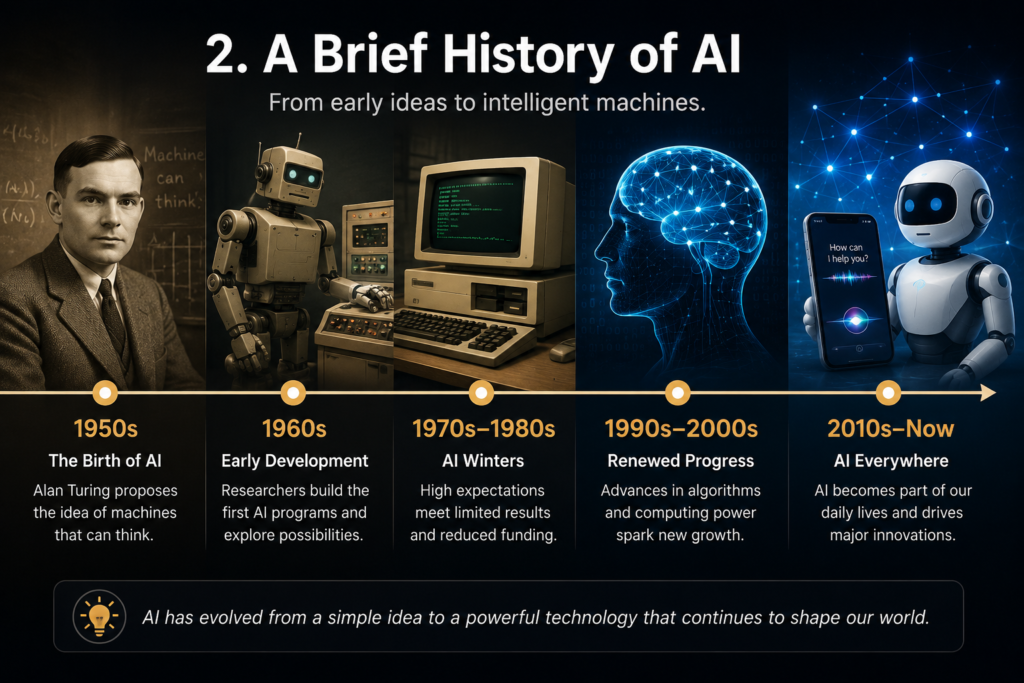
Although Artificial Intelligence may seem like a modern invention, its origins date back several decades. The idea of creating machines capable of thinking and solving problems like humans has fascinated scientists, mathematicians, and philosophers for generations.
The journey began in the 1950s, when British mathematician Alan Turing introduced the idea that machines could one day simulate human intelligence. In 1950, he published Computing Machinery and Intelligence, introducing what later became known as the Turing Test—a method for determining whether a machine could exhibit intelligent behavior similar to that of a human.
A few years later, in 1956, the term Artificial Intelligence was officially introduced during the Dartmouth Summer Research Project. Organized by computer scientist John McCarthy, the conference brought together researchers who believed that machines could eventually perform tasks requiring human intelligence. This event is widely considered the birth of AI as a scientific field.
During the following decades, AI experienced periods of rapid progress followed by setbacks. Early researchers developed programs capable of solving mathematical problems and playing simple games, creating excitement about the technology’s future. However, computers at the time lacked the processing power and data needed to support more advanced AI systems.
These limitations led to periods known as the AI Winters, when funding and public interest declined because expectations had outpaced technological capabilities.
The return of faster computers, cloud computing, and access to massive datasets helped revive AI research and opened the door to the breakthroughs we see today.
Everything changed in the 1990s and early 2000s as computers became faster and the internet generated enormous amounts of digital data. These advances allowed researchers to develop more sophisticated algorithms that could learn from experience instead of relying solely on predefined rules.
One of the biggest turning points came in 2012, when breakthroughs in deep learning dramatically improved image recognition and speech processing. From that point on, AI began advancing at an unprecedented pace.
Today, Artificial Intelligence powers many of the digital services we use every day. Virtual assistants, recommendation systems, language translation, medical diagnostics, autonomous vehicles, and generative AI tools like ChatGPT have demonstrated how quickly the technology has evolved from an academic concept into a practical tool used by millions around the world.
The history of AI shows that innovation often happens in cycles. Decades of research, combined with modern computing power and vast amounts of data, have transformed Artificial Intelligence into one of the most influential technologies of the 21st century.
Key Milestones in AI History
- 1950 – Alan Turing proposes the Turing Test.
- 1956 – The term Artificial Intelligence is coined at the Dartmouth Conference.
- 1970s–1980s – AI experiences periods of slower progress known as the AI Winters.
- 1997 – IBM’s Deep Blue defeats world chess champion Garry Kasparov.
- 2012 – Deep learning achieves major breakthroughs in image recognition.
- 2020s – Generative AI becomes mainstream, through tools like ChatGPT, image generators, and AI coding assistants.
How Does Artificial Intelligence Work?
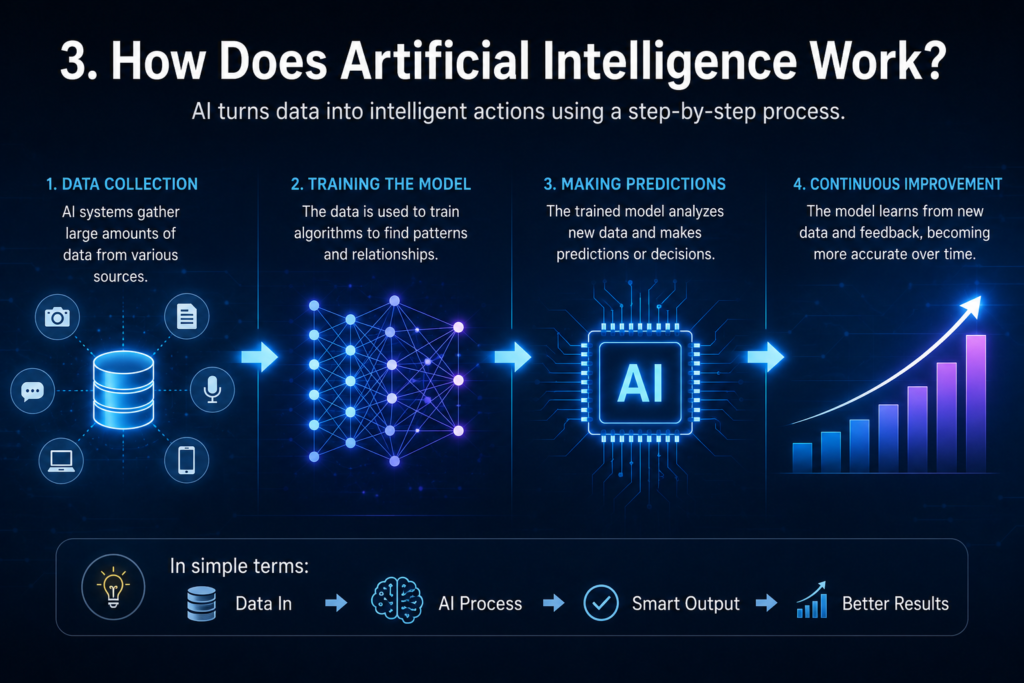
Artificial Intelligence works by combining large amounts of data with advanced algorithms that enable computers to recognize patterns, learn from experience, and make decisions. Instead of being explicitly programmed for every possible situation, AI systems improve their performance by analysing data and identifying the most effective solutions over time.
At the heart of most modern AI systems is a process called machine learning. Rather than following a fixed set of rules, machine learning allows computers to learn from examples. The more relevant data an AI system receives, the better it becomes at recognizing patterns and making accurate predictions.
For example, imagine you want to teach an AI to identify cats in photos. The system doesn’t actually understand what a cat is. Instead, it learns to recognize statistical patterns that frequently appear in cat images. Instead of writing thousands of rules describing what a cat looks like, you provide the system with millions of labeled images of cats and other animals. Over time, the AI learns to recognize common features such as ears, eyes, whiskers, and body shapes. Eventually, it can identify cats in images it has never seen before.
The process generally follows four main steps:
1. Data Collection
Every AI system starts with data. This data can include text, images, videos, audio recordings, sensor information, or numerical data. High-quality data is essential because AI can only learn from the information it receives.
2. Training the Model
Once enough data has been collected, developers use it to train an AI model. During training, the system analyzes thousands—or even millions—of examples to identify patterns and relationships. Depending on the complexity of the model, training can take hours, days, or even weeks.
3. Making Predictions
After training, the AI can apply what it has learned to new situations. It can recognize faces, translate languages, recommend products, detect fraud, or answer questions based on patterns it discovered during training.
4. Continuous Improvement
Many AI systems continue learning as they receive new information. This allows them to adapt to changing conditions and improve their accuracy over time. For example, streaming platforms refine their recommendations as users watch more content, while navigation apps improve traffic predictions using live data from millions of drivers.
Machine Learning vs. Deep Learning
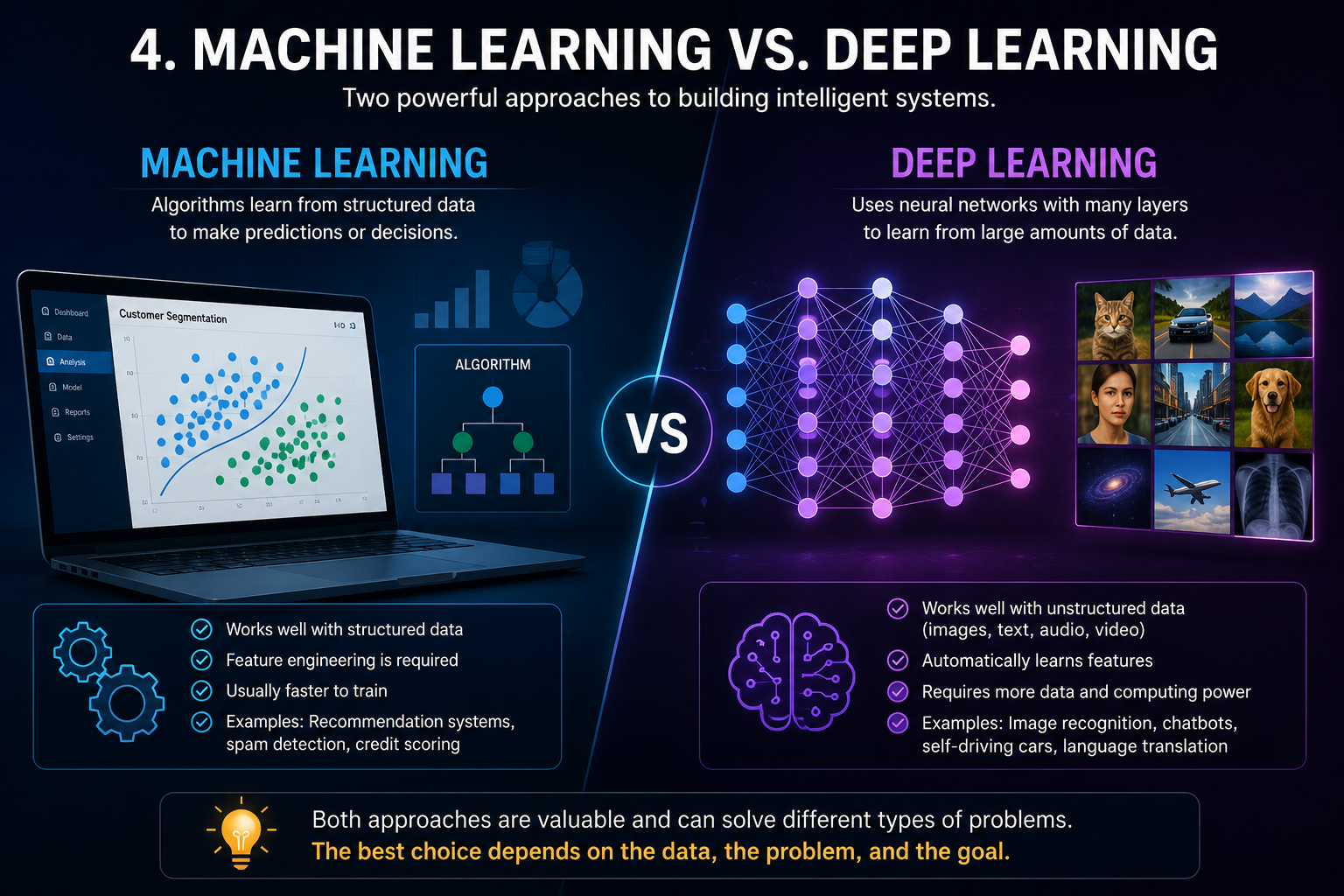
As you learn more about AI, you’ll often come across two important terms: Machine Learning and Deep Learning.
Machine Learning is a branch of Artificial Intelligence that enables computers to learn from data without being explicitly programmed for every task.
Deep Learning is a more advanced form of machine learning that uses artificial neural networks inspired by the structure of the human brain. These networks can process enormous amounts of data, making them particularly effective for tasks such as image recognition, speech recognition, language translation, and generative AI.
Although these terms are sometimes used interchangeably, deep learning is actually a subset of machine learning, and both are key technologies behind today’s most advanced AI systems.
Why AI Keeps Improving
One of the reasons Artificial Intelligence has advanced so rapidly is its ability to learn and improve over time. As computing power increases and more data becomes available, AI models become more accurate, efficient, and capable of handling increasingly complex tasks.
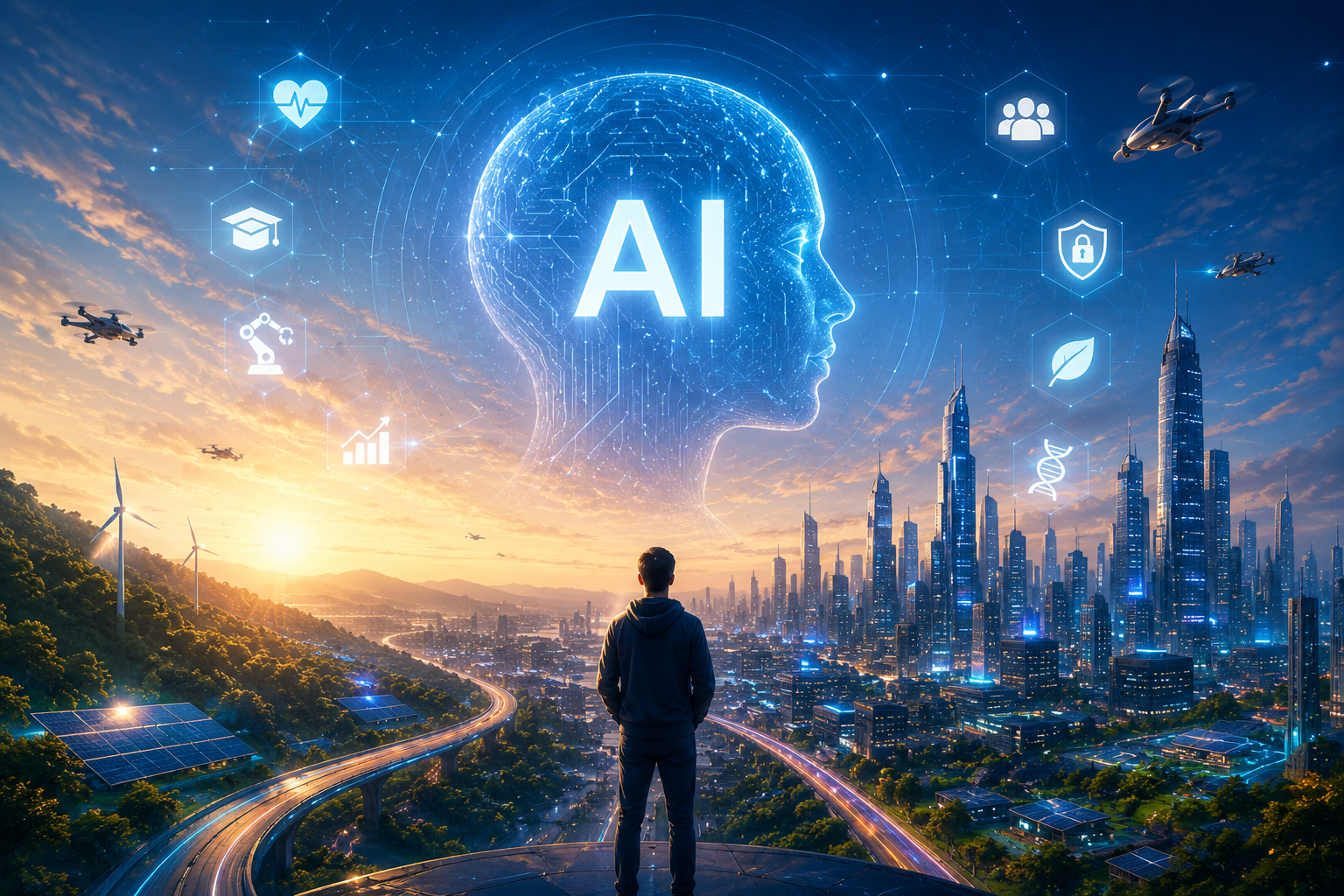
This ability to learn and adapt is one of the main reasons why Artificial Intelligence has advanced so rapidly in recent years and is now transforming industries across the globe.
In short: Artificial Intelligence works by collecting data, learning from patterns through algorithms, making predictions or decisions, and continuously improving as it processes more information.
Types of Artificial Intelligence
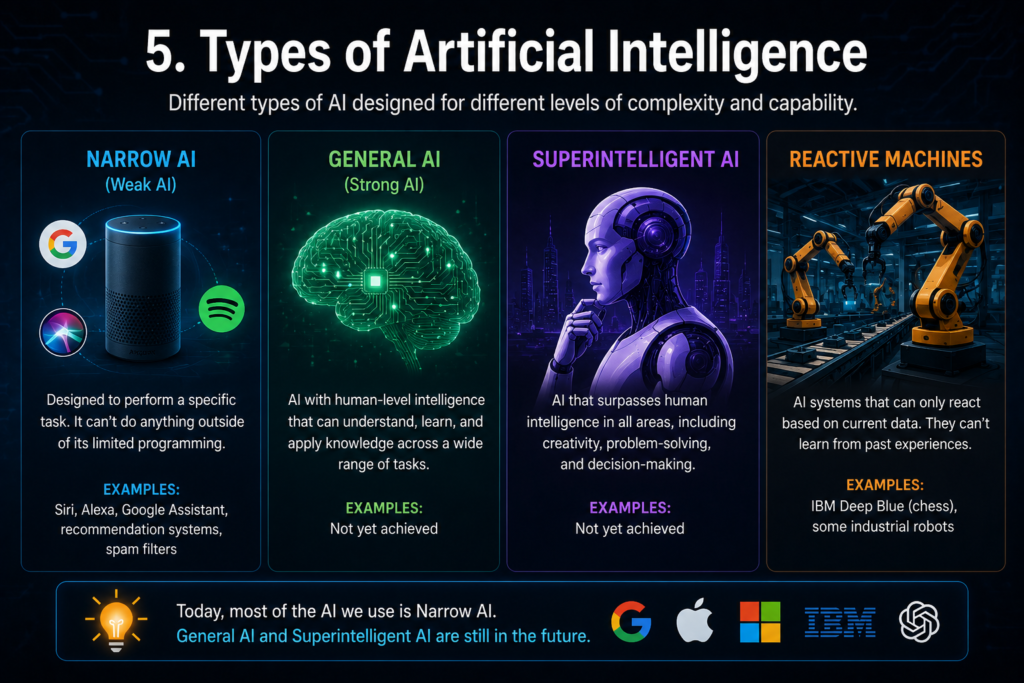
Artificial Intelligence can be classified in different ways, but the most common approach is based on its capabilities. Although today’s AI systems are already transforming industries, they represent only one stage in the broader evolution of artificial intelligence.
Let’s explore the three main types of AI and see how they differ.
1. Narrow AI (Weak AI)
Narrow AI, also known as Weak AI, is the only type of Artificial Intelligence that exists today. These systems are designed to perform specific tasks and cannot operate beyond the functions they were created for.
Although Narrow AI can outperform humans in certain activities, it does not possess consciousness, emotions, or genuine understanding. Instead, it uses data and algorithms to complete tasks with remarkable speed and accuracy.
Common examples of Narrow AI include:
- Virtual assistants like Siri and Google Assistant
- Chatbots for customer support
- Recommendation systems used by Netflix and Spotify
- Email spam filters
- Facial recognition technology
- AI-powered translation tools
Despite these limitations, Narrow AI has become an essential part of modern life and continues to improve as more data becomes available.
2. General AI (Strong AI)
General AI, often called Strong AI or Artificial General Intelligence (AGI), refers to a theoretical form of AI that can understand, learn, and perform any intellectual task that a human can.
Unlike Narrow AI, which is built for a single purpose, General AI would be capable of reasoning, adapting to unfamiliar situations, solving problems across different fields, and transferring knowledge from one task to another.
For example, a General AI system could learn a new language, diagnose medical conditions, write software, compose music, and solve scientific problems—all without requiring separate programming for each task.
At present, General AI does not exist. While recent advances in AI are impressive, today’s systems remain specialized and lack true human-level understanding.
3. Superintelligent AI
The final category is Superintelligent AI, a hypothetical form of intelligence that would surpass human capabilities in virtually every area.
A superintelligent system could potentially outperform the world’s leading experts in science, engineering, medicine, creativity, and strategic thinking. It might develop new technologies, solve complex global challenges, and make discoveries beyond current human understanding.
However, Superintelligent AI remains a topic of research and debate rather than reality. Scientists, technology leaders, and policymakers continue to discuss both its potential benefits and the ethical challenges it could present if it were ever developed.
Other Ways to Classify AI
Artificial Intelligence can also be categorized based on how it functions. Researchers often describe four functional types:
- Reactive Machines – AI systems that respond only to current information without storing memories.
- Limited Memory AI – Systems that learn from past data to improve future decisions. Most modern AI applications fall into this category.
- Theory of Mind AI – A future concept in which AI could understand human emotions, beliefs, and intentions.
- Self-Aware AI – A purely hypothetical form of AI that would possess consciousness and self-awareness.
While these categories are useful for understanding how AI could evolve, only the first two are reflected in today’s technologies.
Which Type of AI Do We Use Today?
The Artificial Intelligence used in smartphones, search engines, recommendation systems, autonomous vehicles, and generative AI tools all belongs to the Narrow AI category. These systems are highly capable within their specific domains but cannot think or reason like humans across a wide range of tasks.
Although researchers continue working toward General AI, today’s AI remains highly specialized. Even the most advanced AI systems are designed to perform specific tasks rather than possess human-like intelligence.
In summary: Today’s AI is powerful but specialized. Narrow AI is already changing the world, while General AI and Superintelligent AI remain ambitious goals that could redefine the future of technology.
Real-World Applications of AI
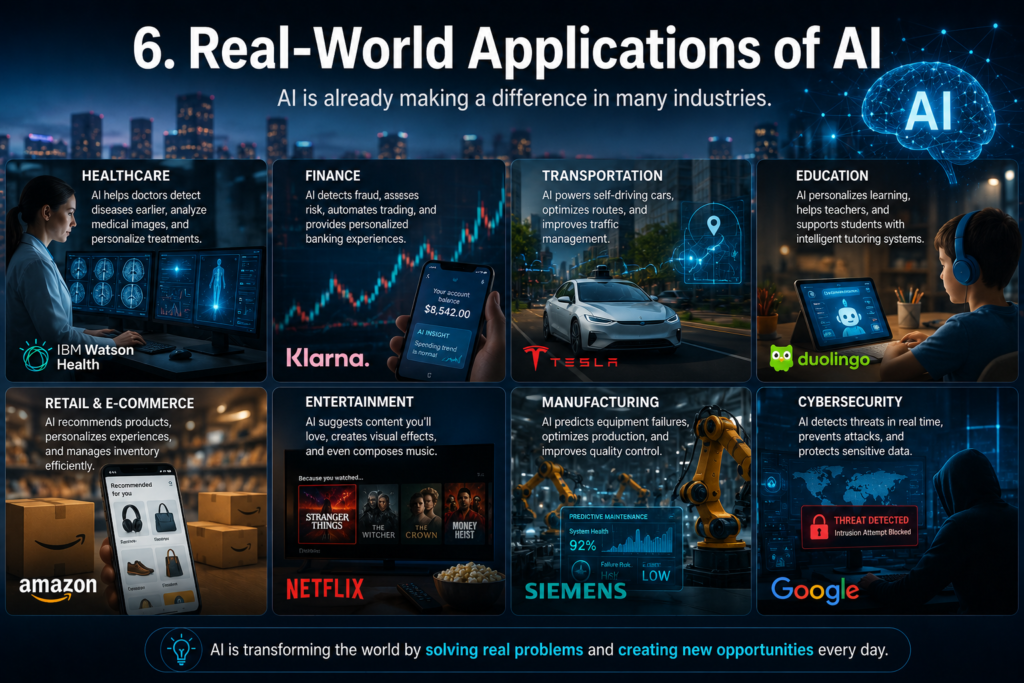
Artificial Intelligence is no longer a technology of the future—it’s already part of our everyday lives. From the moment we unlock our smartphones in the morning to the time we watch a movie before bed, AI is quietly working in the background to make digital experiences faster, smarter, and more personalized.
As the technology continues to evolve, businesses and organizations across nearly every industry are finding new ways to use AI to improve efficiency, reduce costs, and solve complex problems.
Here are some of the most common real-world applications of Artificial Intelligence.
Healthcare
AI is transforming healthcare by helping doctors diagnose diseases more accurately and efficiently. Machine learning models can analyze medical images, identify patterns in patient data, and assist healthcare professionals in detecting conditions such as cancer, heart disease, and neurological disorders.
AI also supports drug discovery, robotic surgery, and personalized treatment plans, making healthcare more precise and accessible.
Finance
Banks and financial institutions use AI to detect fraudulent transactions, assess financial risks, and automate customer support through intelligent chatbots.
AI-powered algorithms can analyze massive amounts of financial data in real time, helping businesses and investors make better-informed decisions while improving security.
Transportation
Artificial Intelligence plays a major role in modern transportation. Navigation apps use AI to predict traffic conditions and recommend the fastest routes, while advanced driver-assistance systems improve vehicle safety.
Self-driving cars also rely heavily on AI to interpret their surroundings, recognize road signs, detect pedestrians, and make driving decisions.
Education
Educational platforms use AI to create personalized learning experiences based on each student’s progress and learning style.
AI can recommend study materials, provide instant feedback on assignments, automate administrative tasks, and even assist teachers in identifying students who may need additional support.
Entertainment
Many popular streaming services use AI to recommend movies, TV shows, and music based on your interests and previous activity.
Content recommendation systems analyze viewing habits, listening preferences, and user behavior to deliver a more more tailored entertainment experience.
Retail and E-Commerce
Online retailers use AI to improve customer experiences through personalized product recommendations, dynamic pricing, and intelligent search features.
AI also helps businesses manage inventory, forecast demand, and optimize delivery routes, making online shopping faster and more efficient.
Manufacturing
Manufacturing companies use AI-powered robots and predictive maintenance systems to improve production efficiency and reduce downtime.
By analyzing sensor data from machines, AI can predict equipment failures before they happen, helping businesses save time and reduce maintenance costs.
Customer Service
AI-powered virtual assistants and chatbots now handle millions of customer inquiries every day.
These systems can answer frequently asked questions, process requests, and provide 24/7 support, allowing human agents to focus on more complex issues.
Cybersecurity
As cyber threats become more sophisticated, AI is playing an increasingly important role in digital security.
Artificial Intelligence can detect unusual network activity, identify potential cyberattacks, and respond to threats much faster than traditional security systems.
Everyday AI You Already Use
Even if you don’t realize it, you’re probably using Artificial Intelligence every day. Some familiar examples include:
- Voice assistants like Siri, Alexa, and Google Assistant.
- Google Search predictions and autocomplete.
- Netflix and Spotify recommendations.
- Email spam filters.
- Face recognition for unlocking smartphones.
- Online translation tools.
- Smart home devices.
- Generative AI assistants like ChatGPT.
These applications demonstrate how AI has moved beyond research laboratories and become an essential part of modern life.
The key takeaway: Artificial Intelligence is already improving healthcare, finance, transportation, education, entertainment, cybersecurity, and countless other industries. As the technology continues to advance, its influence on our daily lives will only become more significant.
Benefits of Artificial Intelligence
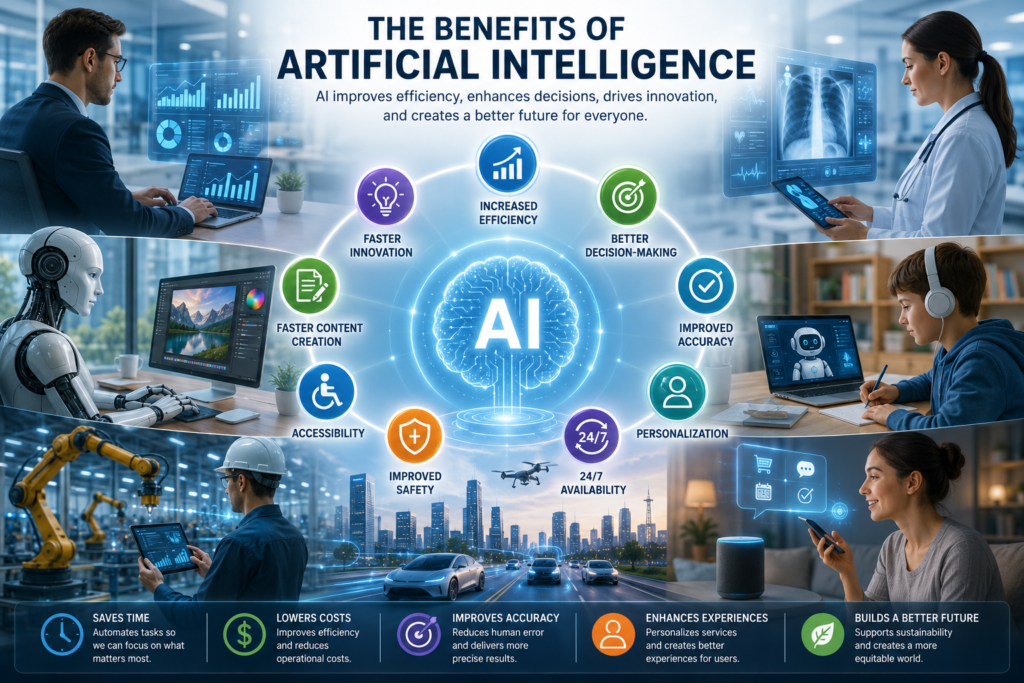
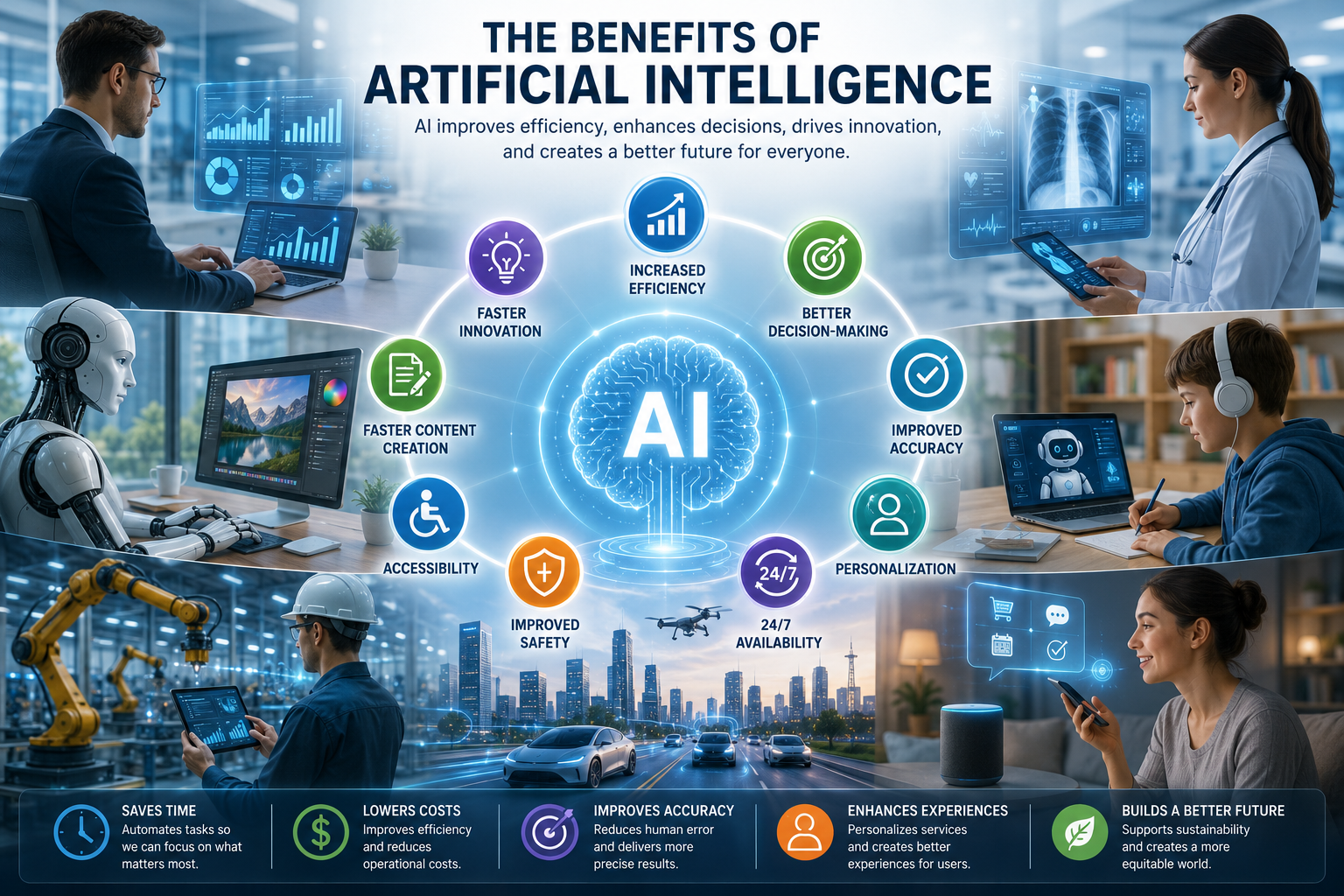
Artificial Intelligence has become one of the most influential technologies of the modern era because of its ability to solve problems, improve efficiency, and support better decision-making. From businesses and healthcare providers to students and everyday consumers, AI is creating new opportunities across almost every sector.
While the technology continues to evolve, many of its benefits are already visible in our daily lives.
Increased Efficiency
One of the biggest advantages of AI is its ability to perform repetitive tasks quickly and accurately. Activities that once required hours of manual work can now be completed in minutes, allowing people to focus on more complex and creative responsibilities.
Businesses use AI to automate processes such as data entry, scheduling, inventory management, and customer support, improving productivity while reducing operational costs.
Better Decision-Making
AI can analyze enormous amounts of data far faster than any human. By identifying patterns and trends that might otherwise go unnoticed, AI helps individuals and organizations make more informed decisions.
This capability is particularly valuable in industries such as finance, healthcare, and scientific research, where accurate data analysis can have a significant impact.
Faster Content Creation
AI is helping writers, designers, programmers, and marketers create content more efficiently. From generating ideas and writing code to editing images and producing reports, AI-powered tools are increasing productivity across creative and technical professions.
Improved Accuracy
When properly trained with high-quality data, AI systems can perform certain tasks with remarkable precision.
For example, AI can assist doctors in detecting diseases from medical images, help manufacturers identify product defects during production, and enable financial institutions to detect fraudulent transactions in real time.
Although AI is not perfect, it can significantly reduce human error in many situations.
Personalization
Many of the digital services we use every day rely on AI to create personalized experiences.
Streaming platforms recommend movies based on your viewing history, online stores suggest products that match your interests, and music services create playlists tailored to your listening habits.
This level of personalization helps users discover relevant content while improving their overall experience.
24/7 Availability
Unlike humans, AI systems don’t need breaks or sleep. Virtual assistants and AI-powered chatbots can provide support at any time of the day, helping businesses serve customers around the clock.
This continuous availability improves customer satisfaction while allowing companies to respond more quickly to requests and inquiries.
Faster Innovation
Artificial Intelligence is accelerating innovation across multiple industries.
Researchers use AI to develop new medicines, engineers design smarter machines with its assistance, and scientists analyze massive datasets to make discoveries that would have taken years using traditional methods.
By processing information at incredible speeds, AI enables faster progress in fields ranging from medicine to space exploration.
Improved Safety
AI is also helping make workplaces, transportation systems, and public services safer.
Modern vehicles use AI-powered safety features to detect potential collisions, maintain lane positioning, and assist drivers in avoiding accidents. In industrial environments, AI can monitor equipment, identify hazards, and predict failures before they occur.
These technologies help reduce risks while protecting both workers and the public.
Accessibility
Artificial Intelligence is making technology more accessible for people around the world.
Speech recognition helps users interact with devices using their voice, real-time translation breaks down language barriers, and image recognition assists people with visual impairments by describing objects and surroundings.
These innovations are helping create more inclusive digital experiences.
The Bigger Picture
The true value of Artificial Intelligence lies in its ability to work alongside humans rather than replace them entirely. By automating repetitive tasks, analyzing complex information, and supporting better decisions, AI allows people to focus on creativity, critical thinking, and solving problems that require human judgment.
As the technology continues to evolve, its benefits are expected to expand even further, creating new opportunities for businesses, researchers, and individuals alike.
In summary: Artificial Intelligence improves efficiency, increases accuracy, supports better decision-making, delivers personalized experiences, drives innovation, enhances safety, and makes technology more accessible. These advantages explain why AI is becoming an essential part of modern life and one of the fastest-growing technologies in the world.
Challenges and Risks of AI
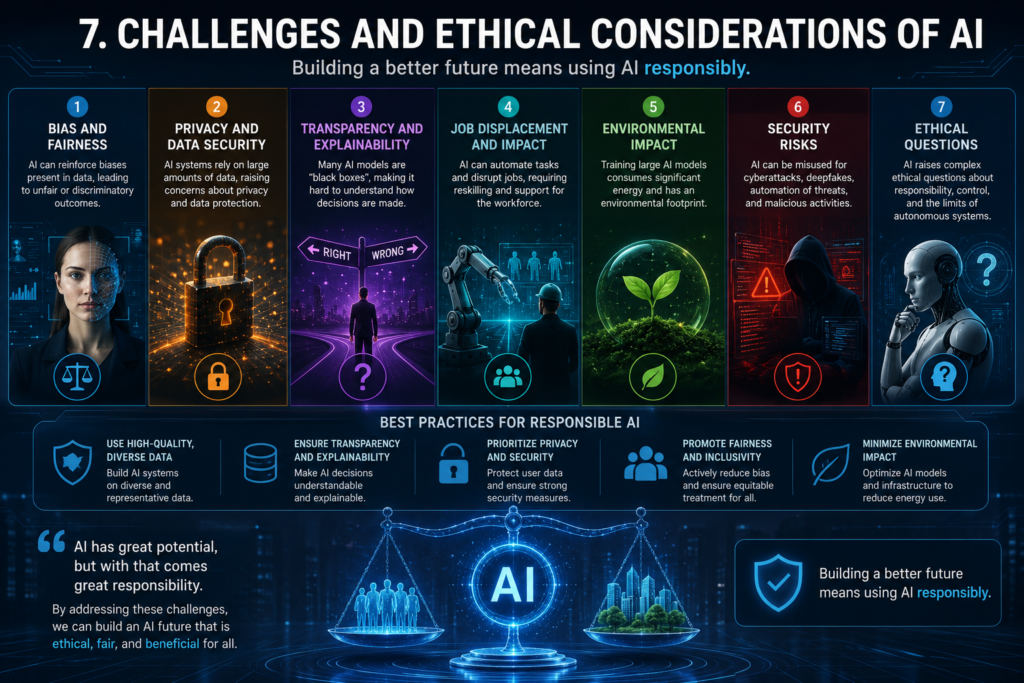
While Artificial Intelligence offers remarkable benefits, it also presents important challenges that cannot be ignored. As AI becomes more integrated into our daily lives, governments, businesses, and researchers are working to ensure the technology is developed and used responsibly.
Understanding these challenges is essential to gaining a balanced view of Artificial Intelligence.
Job Displacement
One of the most widely discussed concerns is the impact of AI on employment.
As AI systems become capable of automating repetitive and routine tasks, some jobs may change or even disappear. Industries such as manufacturing, customer service, and transportation are already adopting automation to improve efficiency.
However, history shows that technological advancements also create new opportunities. While some roles may decline, new careers in AI development, cybersecurity, data science, and technology management are emerging. The challenge will be helping workers develop the skills needed for these evolving industries.
Privacy Concerns
AI systems often rely on large amounts of data to function effectively. This data may include personal information such as browsing habits, location history, online purchases, or medical records.
If this information is collected or used without proper safeguards, it can raise serious privacy concerns. Organizations must handle personal data responsibly and comply with data protection laws to maintain public trust.
Bias and Fairness
Artificial Intelligence is only as good as the data it learns from.
If an AI system is trained using biased or incomplete data, it may produce unfair or inaccurate results. This can affect important decisions in areas such as hiring, lending, healthcare, or law enforcement.
Reducing bias requires diverse datasets, regular testing, and continuous monitoring to ensure AI systems treat people fairly.
Security Risks
As AI becomes more powerful, it can also be misused.
Cybercriminals may use AI to create more convincing phishing attacks, generate realistic fake content, or automate cyberattacks. At the same time, organizations are using AI to strengthen cybersecurity by detecting threats faster than traditional systems.
This creates an ongoing race between attackers and defenders, making digital security more important than ever.
Misinformation and Deepfakes
Generative AI has made it easier than ever to create realistic text, images, audio, and videos.
While these tools have many legitimate uses, they can also be exploited to spread misinformation or create deepfakes—highly convincing fake media designed to imitate real people.
As these technologies continue to improve, verifying the authenticity of online content will become increasingly important.
Ethical Questions
Artificial Intelligence also raises complex ethical issues.
For example:
- Who is responsible if an autonomous vehicle causes an accident?
- Should AI be allowed to make decisions in healthcare or law enforcement?
- How much control should AI have over critical systems?
These questions have no simple answers and continue to be debated by governments, researchers, and technology companies around the world.
Dependence on AI
As AI becomes more capable, there is a risk that people may become overly dependent on automated systems.
While AI can improve productivity and simplify many tasks, human judgment, creativity, and critical thinking remain essential. AI should be viewed as a tool that supports people rather than replacing human decision-making entirely.
Balancing Innovation and Responsibility
The future of Artificial Intelligence depends not only on technological progress but also on responsible development.
Governments are introducing new regulations, companies are investing in AI safety, and researchers are exploring ways to make AI systems more transparent, secure, and accountable.
By balancing innovation with ethical responsibility, society can maximize the benefits of AI while reducing its potential risks.
Key takeaway: Artificial Intelligence has enormous potential, but it also brings challenges related to employment, privacy, bias, security, misinformation, and ethics. Addressing these issues responsibly will play a crucial role in shaping the future of AI.
The Future of Artificial Intelligence
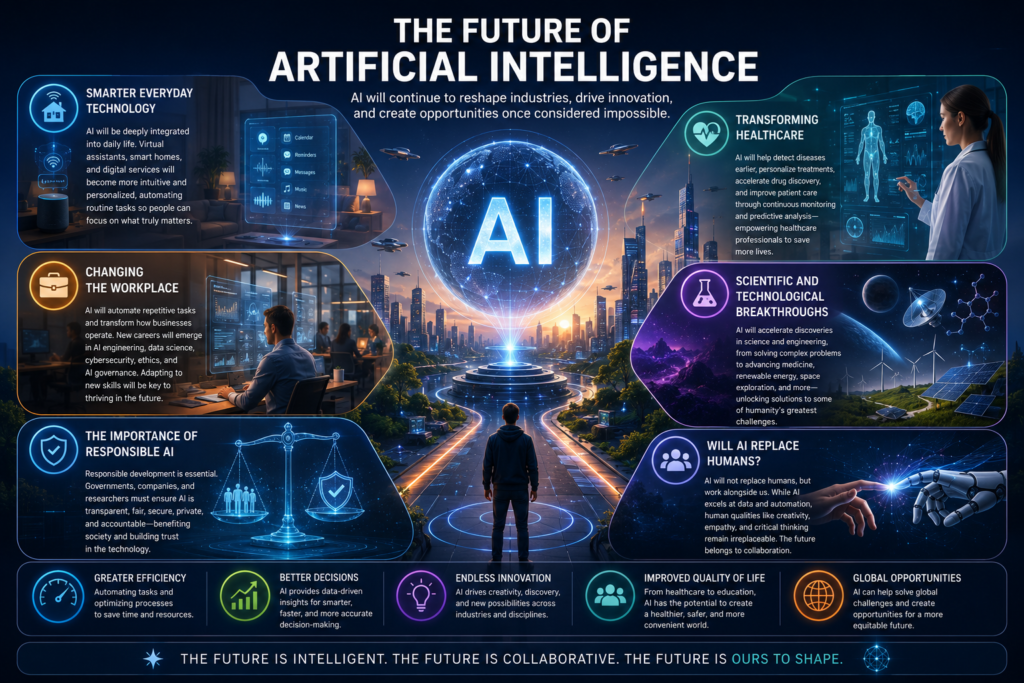
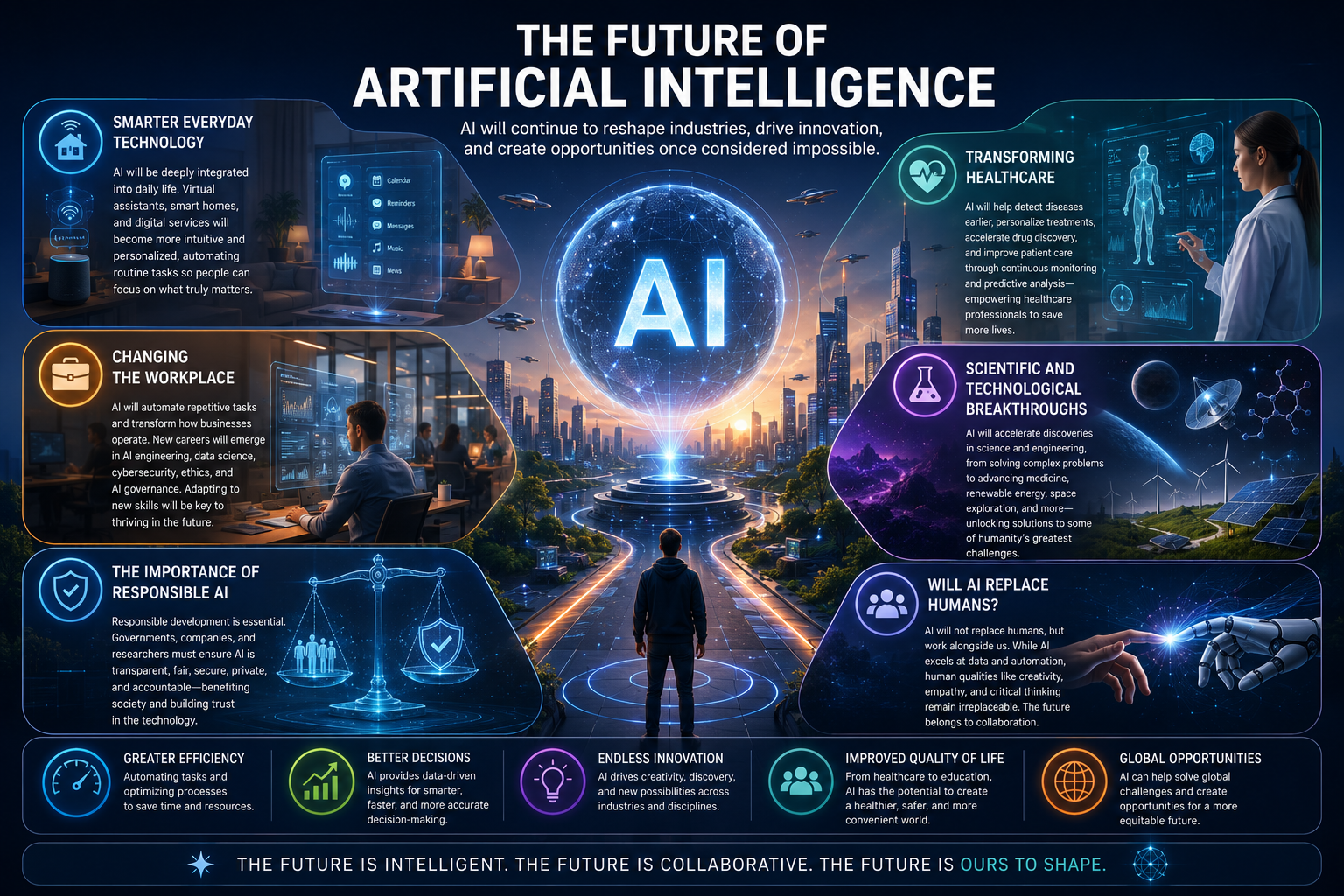
Artificial Intelligence is evolving at an extraordinary pace, and its influence is expected to grow significantly in the coming years. As computing power increases, AI models become more advanced, and access to data continues to expand, the technology will play an even greater role in how we live, work, and interact with the world.
Although it’s impossible to predict exactly what the future holds, one thing is clear: AI will continue to reshape industries, drive innovation, and create opportunities that were once considered impossible.
Smarter Everyday Technology
In the near future, AI will become even more integrated into our daily routines.
Virtual assistants will better understand natural conversations, smart homes will become more intuitive, and digital services will provide increasingly personalized experiences. Many routine tasks could be automated, allowing people to spend more time on activities that require creativity, problem-solving, and human interaction.
Transforming Healthcare
Healthcare is expected to remain one of the industries most impacted by AI.
Future AI systems may help doctors detect diseases earlier, develop highly personalized treatment plans, accelerate the discovery of new medicines, and improve patient care through continuous monitoring and predictive analysis.
Rather than replacing healthcare professionals, AI will likely become a valuable tool that supports faster and more accurate medical decisions.
Changing the Workplace
Artificial Intelligence will continue to transform the way businesses operate.
Many repetitive tasks will become automated, allowing employees to focus on strategic planning, creativity, and complex decision-making. At the same time, entirely new careers will emerge in fields such as AI engineering, data science, cybersecurity, ethics, and AI governance.
As with previous technological revolutions, adapting to new skills will become increasingly important.
Scientific and Technological Breakthroughs
AI has the potential to accelerate discoveries in science and engineering.
Researchers are already using AI to study climate change, develop advanced materials, explore space, and solve complex mathematical problems. As AI systems become more capable, they could help scientists make discoveries that would otherwise take decades.
These advancements could have a profound impact on medicine, renewable energy, agriculture, and many other fields.
The Importance of Responsible AI
As Artificial Intelligence becomes more powerful, responsible development will become even more important.
Governments, technology companies, and research institutions are working to establish regulations and ethical guidelines that promote transparency, fairness, privacy, and accountability.
The long-term success of AI will depend not only on technological progress but also on ensuring that these systems are developed in ways that benefit society as a whole.
Will AI Replace Humans?
One of the most common questions about Artificial Intelligence is whether it will eventually replace humans.
While AI is exceptionally good at processing information and automating repetitive tasks, it still lacks qualities such as emotional intelligence, empathy, creativity, and moral judgment. These uniquely human abilities remain essential in countless professions and everyday situations.
For the foreseeable future, AI is more likely to work alongside people rather than replace them entirely. The most successful future will probably be one in which humans and AI collaborate, combining the efficiency of machines with the creativity and critical thinking of people.
Looking Ahead
Artificial Intelligence is still in its early stages, and its full potential has yet to be realized. The decisions made today—by researchers, businesses, governments, and individuals—will shape how this technology develops in the years ahead.
Whether it’s improving healthcare, making transportation safer, accelerating scientific discoveries, or changing the way we work, AI is set to become one of the defining technologies of the 21st century.
The future of Artificial Intelligence is not just about smarter machines—it’s about how humans choose to use this powerful technology to solve real-world problems and improve lives.
About Rydexora
Rydexora is an independent technology publication covering artificial intelligence, consumer technology, robotics, cybersecurity, software, and digital innovation. We create clear, accurate, and well-researched content that helps readers understand today’s technology, emerging trends, and the innovations shaping tomorrow.
One Response